
Opinion
You can also read this as a zine on HeyZine – this version is not accessible.
A little while ago, I asked people what words they would use to describe content folks. These are a few of the most common things they said:
- Analytical
- Bold
- Deep thinkers
- Strategic
- Good listeners
- Thoughtful
- Empathetic
- Visionary
- Focused
- Curious
No one said creative. And that interests me.
Why don’t we see content as creative?
I’m fascinated by this question of creativity and how it fits with content.
I’m a content strategist/designer and also a frustrated creative. I’ve been frustrated with my creativity since I was 16, when my very academic school wouldn’t let me study A-Level art, because they didn’t think I was good enough (a hammer blow to my ego).
In my first content jobs I was always on the edge of creative things and not part of the right teams or processes.
Outside work, my creative practice is always deprioritised, which is the source of a lot of angst.
A lot of my clients seem to be frustrated creatives too. In my consultancy work, creativity is a common pain point and something that affects both performance and joy at work.
At the heart of it, I think there’s a lack of belief in the compatibility of content and creativity.
Are content and creativity compatible?
Sometimes it’s a sense that you don’t need to tap into your creativity. That ‘creative’ is for designers, brand folk and marketers. There can be pride in this – and perhaps a little bit of snobbery, too. A sense that content is elevated, because it’s evidence-based and closer to a social science.
Sometimes the limits are imposed from elsewhere. Many content teams feel shut out of creative work and processes by stakeholders, peers, bosses and prescriptive briefs.
And too many teams don’t know how to create together. They’re so locked into reactive working, so focused on delivery, so keen to do things by the book, that engaging with a problem creatively can feel intimidating, unfamiliar, or like a waste of time.
Everyone and everything is creative
I think we need to rethink what creativity means. Starting with this fundamental principle: everyone and everything is creative.
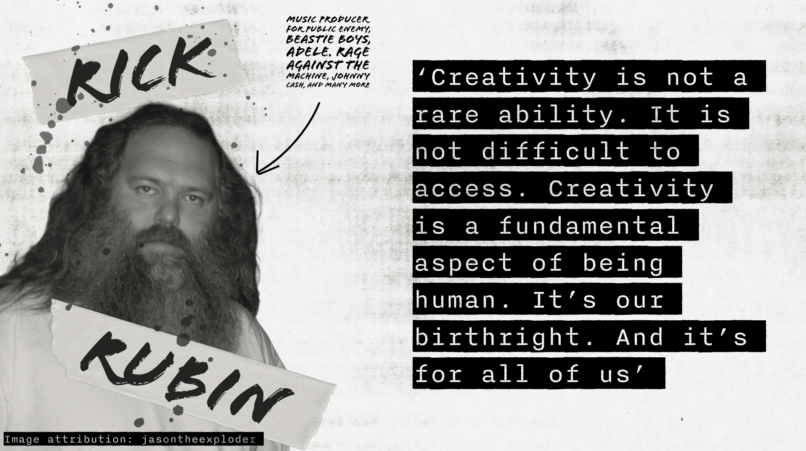
There are so many people who don’t see themselves as creative. Perhaps because they believe that creativity is an innate quality, something you’re good at or bad at. That makes me sad. Like Rick Rubin says, creativity is for all of us, a fundamental part of our humanity. Feeling a creative spark is one of the things that helps make work more enjoyable. And if we want to get late-stage capitalist about it, it makes you a more valuable, irreplaceable employee.
Another narrative is that our work isn’t creative. That creativity means being good at painting, music, or fiction writing.
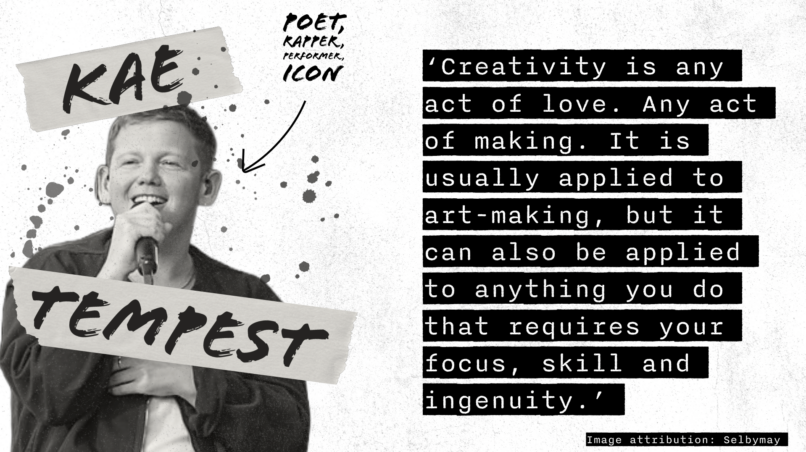
But look at what Kae Tempest says about creativity. Love and making. Focus, skill and ingenuity. That’s us, the content community.
Spending time making sense of complex subject matter to create a messaging hierarchy. Finding the perfect word for a tricky error message. Striving to understand and engage the stakeholder who is being difficult. Coaching a member of your team through a problem they’re struggling with. These things are all creative acts.
Create the conditions for creativity
I think creating the conditions for creativity is one of the responsibilities of a content leader.
At the most basic level, this involves two things: immersion and connection.
1. Immersion
To be creative, you need immersion: time and space to be in the moment and focus on the task at hand. I think there are three things that make a big difference to the level of immersion people feel, and in turn their ability to be creative:
Safety
People need to feel safe to be creative. For some, creating safety might be about developing belief in personal creativity. Others need permission to fail. Because if there’s risk associated with being creative people are less willing to share an idea. We can support each other by patterning the behaviour we want to see:
- Sharing our own failures (and what we learned from them)
- Taking risks (and explaining why we think it’s worth it)
- Avoiding individual blame when something fails (and focusing on what went wrong in the process and systems).
Triage
To make people comfortable with risk, you need to triage. While I believe that any work can be creative, there are some tasks that are better suited to engaging creativity than others. Ask yourself:
- Is the goal clear?
- How much agency do you have?
- How high value/impact/importance is this task?
- How challenging is the task?
- How much time do you have?
Triage tasks based on the results. This is a Goldilocks scenario. You want something where you have just the right combination of importance, challenge, agency, time, and familiarity with the task. Having said all this, there are times where you can just go with the vibes. Robert Sutton’s paper Weird ideas for managing creativity, explains this beautifully. He found that the best ideas for managing creativity and innovation were polar opposites. For example, you could choose the safe path and ignore people who have never solved the exact problem you’re facing and instead look to comparators. Or you can be weird, and ignore the people who’ve solved the problem and look for totally unrelated solutions.
Collaboration
And finally, to be immersed, people need collaborative moments. By that I mean meetings and working sessions and workshops. Which brings me to connection.
2. Connection
When people think ‘genius’ they often think of a white man working alone. But the lone genius is a myth. Michelangelo didn’t paint the Sistine Chapel alone. Picasso was driven by an – apparently friendly – rivalry with Matisse. Even reclusive Emily Dickinson would write poems via correspondence.
Under capitalism, creativity and innovation is all about individual achievement, technological advancement, novelty. But in indigenous tradition, creativity and innovation are deeply rooted in community, intangible heritage, and the intergenerational transmission of knowledge.
Far from being something that happens when a man is alone in a lab or a study or an office, creativity is fed by connection. It thrives when there’s lots of connection between two things: people and ideas.
Connecting people
There’s a bit in his book, On Connection, where Kae Tempest writes:
Creative connection is the use of creativity to access and feel connection and get yourself and those with you in the moment into a more connected space.
Kae was talking about performance. But I think it applies to meetings too.
Creative connection is what we’re trying to foster in content teams. Moments where people can feel immersed and bring their focus, skill and ingenuity to bear on a problem. And meetings are a really important time and opportunity to do that.
But in a lot of organisations, meetings feel like the exact opposite of a creative space. And that’s not a problem with meetings themselves. It’s more about the way people approach them.
As someone who joins a lot of meetings as an outsider, I can tell you that the way most organisations approach meetings is pretty awful. There are too many of them, there’s no agenda and no proper facilitation, and the expectation is that just getting people in the room or on the call and talking a bit will somehow make the magic happen.
But meetings and working sessions can and should be a time and space where great work happens.
I’m a bit evangelical about this, but here’s what I think you need to insist on for every meeting you/your team runs or attends:
- Objective. The goal that will show the meeting was worthwhile.
- Agenda. That’s not just a list of things to cover, a topic to discuss, something to be creative about. It’s a list of specific activities that someone has thought out and considered the best way to facilitate.
- Defined roles. Who is leading/facilitating? Who is taking notes? What’s expected from participants? You also need to make sure you have the right people in the room
- Comfort. You need breaks, snacks, drinks, and daylight if it’s longer than 90 mins.
- Focus. Looking at your phone or laptop to do something else in a working session is counterproductive. Give people permission to focus.
For more on this topic, see Running engaging and productive content workshops.
Connecting ideas
Creativity is all about making new connections between ideas. Rick Rubin calls this ‘source’. You need to be taking in new source material all the time to feed you creativity.
When asked where he got his inspiration from, the artist Jean Michel Basquiat said:
Real life. Books. Television.
Inspiration can come from anywhere. It should be intersectional and interdisciplinary. The more ideas you take on, the more creative you’ll be. Create a conduit for sharing ideas and inspiration. Send people articles to read, have a library of books, go to conferences, have coffee with people and chat. But really, just be interested in the world around you, like Jean-Michel Basquiat.
Taste has a role to play in ideas too. This exchange between Rick Rubin and Anderson Cooper has always stuck with me:
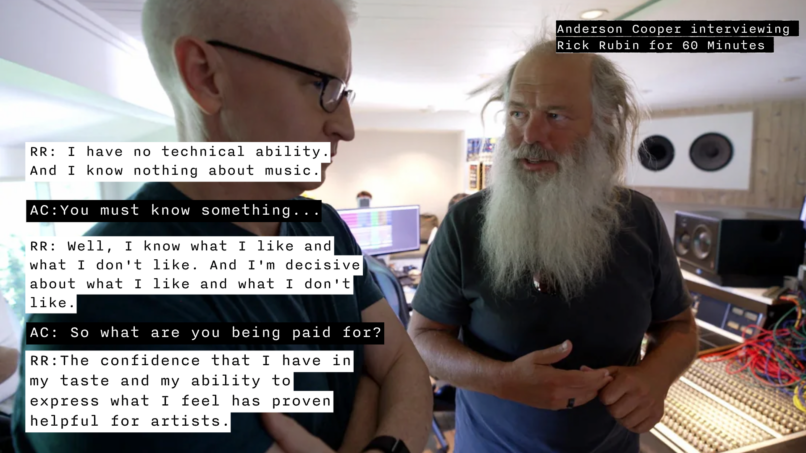
There’s some audacity here for sure, but there’s also something very helpful to pay heed to.
Rick Rubin has been able to help some of the most talented and diverse musical artists of our era make career- and culture-defining records. Not through technical expertise, or being a musician himself, but through taste and communication skills.
I see people holding themselves back, because they’re waiting for an expert to show up and tell them how it should be done. Someone with some mystical source of craft expertise and experience of the right way to do things. But they’re not coming. And here you are. You need to be a bit more Rick Rubin, have a bit more audacity, and trust in your taste and ability to communicate what’s good.
Be a curator, a tastemaker, a critical friend. Develop your taste, your ability to be decisive, and to express feedback in a helpful way to nurture those we lead and our peers.
Best practice is great, but it can only take you so far
This brings me round to the elephant in the room: craft and best practice and evidence.
One of the brilliant things about content, one of the things that’s helped us grow the field and have a sense of community, is a shared sense of the best practice. The fact that so many incredible teams have shared their work, shared their evidence base, and given us a rock to cling to, is huge. And yet, I think sometimes it weighs us down.
Rigidly sticking to the best practice can feel exhausting. And I know that, for a lot of teams, doing content design like it’s written in the book or explained in the boot camp feels impossible in reality.
The way we can police each other on it can be exhausting too. I remember being struck once by someone calling out a former employer – an organisation well-respected for content design – for changing, arguing that it went against the best practice they had established. On one hand, I get it. On the other I wondered, what if something has changed? Why shouldn’t they be able to experiment with something new?
Craft and creativity aren’t mutually exclusive
As Rick Rubin writes:
Rules direct us to average behaviours. If we’re aiming to create works that are exceptional, most rules don’t apply. Average is nothing to aspire to.
You don’t have to throw away the best practice and all your hard-earned craft to be creative. Take the books, the articles, the bootcamps, the conference talks, learn from them. And then leave them behind.
Because your goal isn’t to mimic what’s good. It’s to take what’s good and build on it, push it further, and make something new.
The best way to think about it is not that you have to throw away the best practice and all your hard-earned craft to be creative.
The last thing I will say is this. Best practice has to come from somewhere. It takes someone doing something creative and new to make it happen. Why shouldn’t it be you, your team, and your creativity writing that next chapter?
Reading list
Immaculate Heart College art department rules
This is the Story of a Happy Marriage, Ann Patchett
I Think About Björk’s Creativity Animal a Lot, Josie Thaddeus-Johns
Rick Rubin 60 Minutes interview
*Affiliate link
First published: 12th June 2025
Last reviewed: 27th April 2026
Related resources

Overcoming the ‘everything everywhere all at once’ of content

Reflection questions for people working in content