
Guide

Content last reviewed April 2026
An organising structure is how an institution’s content activities are directed and coordinated. It provides the framework for how work is divided, how different departments or teams interact, and how decisions are made. The right structure can play a big role in helping an organisation achieve its goals through its content.
In my strategic consultancy work, I come across a lot of teams that are struggling because they don’t have a clear organising structure, or they’re using an approach that’s not the right match.
Not all content teams have control over their organising structure. Sometimes the overall structure of the organisation will dictate the structure the content team will take. But some teams can set their own structure, or have enough influence to change this for the better.
The idea behind this guide is to:
- Help you understand what organising structure your team is using (if it’s not already clear)
- Understand the benefits and the risks of different structures
- Get you thinking about what a better structure for your team might look like
The 5 organising structures for content
When it comes down to it, organising structures for content teams are about defining ownership and responsibility for two key things:
- Strategy: Where does responsibility for content strategy sit? Who has decision making power? Who sets standards?
- Execution: Where does responsibility for producing/creating content sit? Who makes what content?
I see 5 main kinds of organising structures, each with slightly different approaches to ownership of strategy and execution. They also have different strengths and weaknesses across 3 key factors:
- Control: Degree to which content is controlled. This can have a big impact on the consistency and quality of content across different products, services, or teams.
- Scalability: Ability to adapt to demand, and changes in the organisation’s size and complexity.
- Agility: The speed and flexibility with which content can be created and adapted.
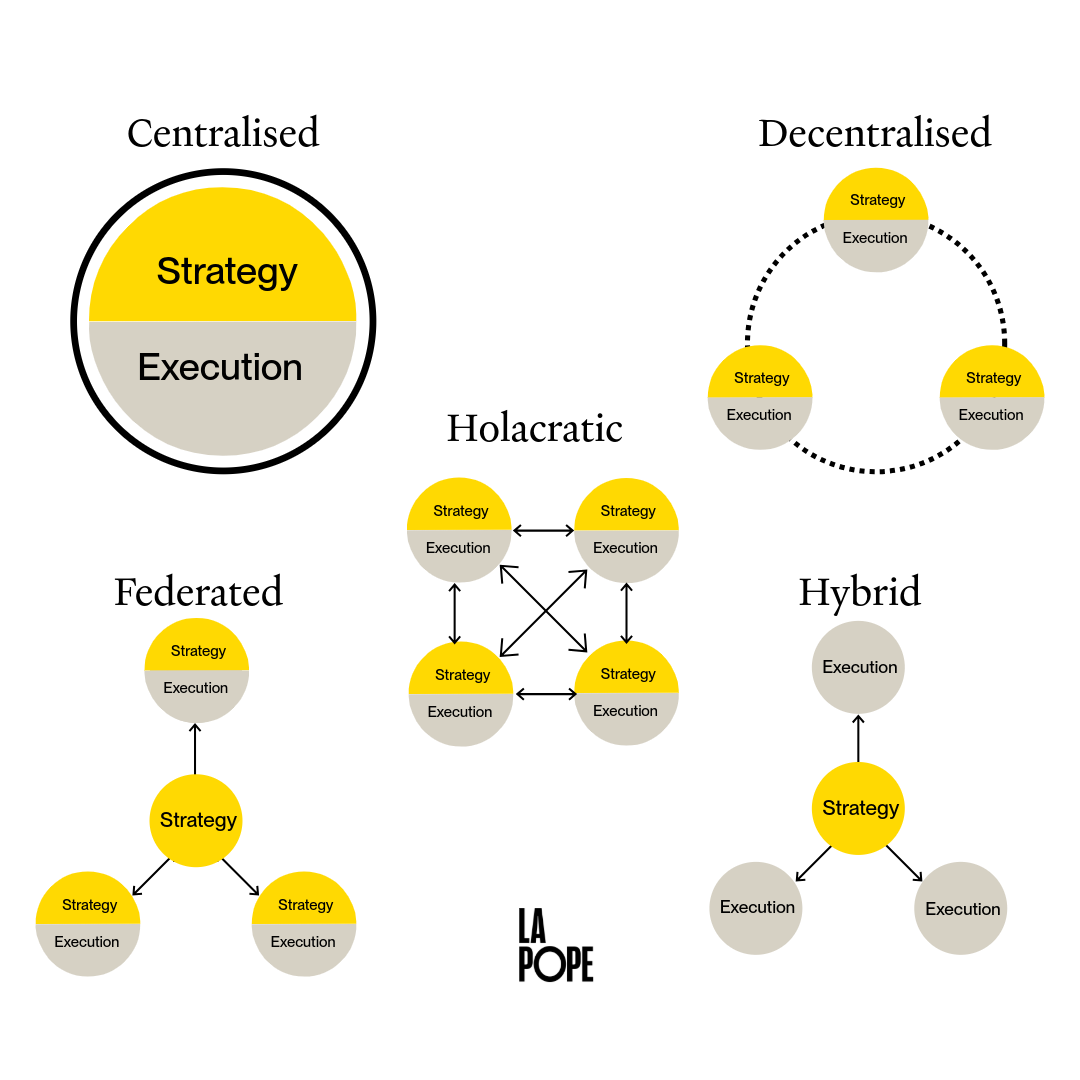
Image description
An infographic titled “Organising structures for content.” It displays five different models, each with a diagram illustrating the relationship between “Strategy” (yellow) and “Execution” (grey).
- Hybrid: A central, all-yellow “Strategy” circle connects down to three all-grey “Execution” circles, showing a central strategy directing multiple execution-only teams.
- Centralised: A single large circle is split horizontally, with the top half labeled “Strategy” and the bottom half “Execution,” showing a top-down structure.
- Decentralised: Three smaller, identical “Strategy/Execution” circles are arranged in a larger dotted circle, indicating independent units.
- Holocratic: Four “Strategy/Execution” circles are at the corners of a square, with arrows showing bidirectional communication between all units, representing an interconnected, non-hierarchical network.
- Federated: A central, all-yellow “Strategy” circle connects down to three smaller “Strategy/Execution” circles, showing a central strategy that guides semi-autonomous units.
Organising structures summary table
| Organising structure | Control | Scalability | Agility |
| Centralised One content team produces all the content for the organisation | High | Low | Low |
| Decentralised Content professionals in cross-functional teams | Low | Medium | Medium |
| Hybrid or ‘hub and spoke’ Centralised standards, decentralised execution | Medium | High | Medium |
| Federated Central team sets rules, devolves execution to non-experts | Low | High | Medium |
| Holacratic Dynamic, self-organising approach | Low | High | High |
1. Centralised
One content team produces all the content for the organisation. In small organisations this might mean that there’s one person, or a small team, taking requests. In larger organisations it could look more like an internal agency, with a large team with specialisms in different formats or content, taking briefs from stakeholders.
This model demands strong project management to make sure requests are tracked, triaged, prioritised and delivered efficiently (more so in larger organisations). It also needs strong strategic direction to avoid marketing/comms/services becoming siloed, and content becoming too tactical.
It’s probably the most common model for content teams, and one that most of us will be familiar with.
Pros:
- Good for keeping close control of your content, brand and messaging
- Potential to be more cost-effective than using agencies or freelancers to produce content
- Builds craft expertise
- Governance is straightforward because decision making sits in one place, BUT…
Cons:
- …content can end up being reactive or overly tactical if the team doesn’t have agency/time to be strategic and content is solely driven by stakeholder needs.
- Content team can become a bottleneck – and this model can be hard to scale
- Inefficiency if content is seen as a single-use resource
- Wider comms and marketing approach can become fragmented
2. Decentralised
There’s no single content team. Instead, there are content professionals in cross-functional teams across the organisation. Those cross-functional teams might be aligned to a particular product, service, market or campaign.
Decentralised teams have the autonomy to produce content that’s relevant to their specific audience or market, and manage it as they see fit. Decentralised teams make control freaks and perfectionists nervous.
Pros
- Works well for organisations that have diverse products or services
- Builds deep understanding of users and subject matter expertise in craft experts – great for complex subject matter and/or demanding stakeholders
- Can be very agile and support innovation
- Can lead to better coordination across comms, marketing, product, etc.
Cons
- High likelihood of silos between products/services
- Inconsistent content across different products/services
- Risk to the strength of the brand overall
3. Hybrid or ‘hub and spoke’
These models are both a mix of centralised and decentralised approaches. Content is created across teams but reviewed or approved centrally for tone, quality and compliance.
In a hybrid model, standards and governance are centralised, but execution is decentralised. In a hub and spoke model, standards and governance are centralised (in a hub) and execution is decentralised to content people (the spokes) who are part of/affiliated to other teams.
This gives a good mix of central control and steering, and autonomy in execution. This is the common sense/happy medium approach for larger organisations. It’s also a good model for content teams that are working on building strategic influence at the highest level of the organisation.
Pros
- Can work well for large, complex or distributed organisations
- Scalable and can work well for growing organisations or those with changing needs
- Builds deep understanding of users and subject matter expertise in craft experts – great for complex subject matter and/or demanding stakeholders
- Can be very agile and support innovation
- Maintains quality, consistency and brand alignment
Cons
- Needs strong leadership and communication
- Centralised sign-off and review can become a bottleneck
- Can be hard to sell in the idea that you need roles dedicated to content governance and strategy
4. Federated
A central content team sets rules, provides support, tools, templates and guidance, and audits/reviews content. Execution is devolved to staff who are not content experts.
This is a pragmatic approach that can work for some organisations and some scenarios. For example, organisations made up of affiliates or local branches, or where there’s a high demand for content but no possibility of scaling the central content team to meet demand. (Some charity folks will recognise these scenarios all too well.) It needs very strong communication and the central roles required are pretty unique. Again, a federated approach is anxiety inducing for people who like control.
Pros
- Can work well for fragmented organisations or those with strong local/regional identity
- Can support deep knowledge of local/specific audiences and subject matter
- Empowers teams by removing content as a blocker or bottleneck
- Content production can easily scale up and down
Cons
- High likelihood of silos
- Inconsistent and poor quality content is more or less inevitable
- Risk to the strength of the brand overall
- High risk that content will be tactical and reactive
5. Holacratic
In holacracy, rather than traditional hierarchical structures, content teams take a dynamic, self-organising approach. It uses ‘circles’ (teams) that have clear roles and responsibilities. For example, you might have circles dedicated to content strategy, content execution, and content measurement. Or alternatively, content folks might be part of circles aligned with different products or services. Each circle operates autonomously but is interconnected with other circles to ensure alignment and coordination. Decision-making is distributed, and individuals have the authority to make decisions within their roles without needing approval from higher-ups.
Holacracy can work for organisations that value agility, innovation, and employee empowerment. It’s not a common approach and it’s radically different to the hierarchical way that most organisations work.
Pros
- Increased agility, flexibility and quick decision-making
- It’s empowering and gives people a strong sense of ownership
- There’s a high level of accountability and transparency
- Roles and responsibilities are clear (or at least they should be…)
- It’s very scalable
Cons
- It’s complicated, unfamiliar to most, and there’s a steep learning curve in adoption
- You’d probably need the whole organisation to work in this way – it’s not something a content team can go it alone with
- The lack of central control can make it hard to maintain consistency
- There’s a communication overhead in keeping circles aligned
Organising structures can be combined
These models aren’t mutually exclusive. If you’re looking at the list and think that you need elements of multiple models, it’s possible.
For example:
- Centralised + hub and spoke: In a centralised content team, you can incorporate elements of hub and spoke by directing content producers to specialise in different subject matter areas.
- Centralised + federated: You could have a centralised team to deal with brand-level content, that also manages a federated organising structure for content and marketing for its local branches.
Changing your organising structure
Making a change to your organising structure is a big deal and shouldn’t be underestimated. It takes a lot of groundwork and implementation. You’ll need:
- Senior level buy in and a compelling business case for making the change
- To design and implement new processes, workflows and technology
- To communicate the change to stakeholders and get their cooperation
- To be willing to monitor and iterate on an ongoing basis to refine your approach
Before you start to implement any kind of change, do some in-depth evaluation and planning.
- Assess your current structure: What are the strengths and weaknesses? How much control, scalability, agility do you have?
- Align to the bigger goals: Look at how well the current structure supports your organisation’s overall objectives and challenges. How would a change of structure make an impact?
- Evaluate the different approaches: Look at the five different structures and evaluate their suitability for your organisation and content.
- Plan in depth: Look at all the things that you need to have in place to make a change. Who needs to approve it? Who is affected by the change? How will you communicate and consult with them? What processes, tools, workflows need to change and how? What guidelines and policies do you need? What will the roles and responsibilities look like?
If you look at all this and think ‘that’s too much’ – I get it. This is the kind of change you should only embark on if it’s necessary and you have the time, drive and permission to make something so ambitious happen. And if you are working on something like this – get in touch, I would love to talk to you.
Published: 18th August 2025