Report22nd September 2025

In my consultancy work, I meet lots of content teams who aren’t reaching their full potential because they don’t have the right organising structure. An organising structure is a model for how content activities are directed and coordinated. It provides the framework for how work is divided, how different departments or teams interact, and how decisions are made. The right structure can play a big role in helping an organisation achieve its goals through its content.
I had thoughts about what works best and why, but I wanted to dig deeper. So I created a survey and 72 (amazing, generous) people responded. I asked them:
What organising structure does your content team use?
- How well do you think your organising structure is working, and why?
- What level of content capability or maturity would you say your organisation has, and why?
- What sector is your organisation in?
- How many people work for your organisation in total?
- How many content folks are there in your organisation in total?
You’ll find their answers in this report. Some really interesting insights emerged, that I hope will be useful for anyone thinking about their organising structure or how to level up their content capability.
Read the full report to learn:
- The most common organising models
- Which models work the best – and why
- The relationship between organisation size and organising structure
- Key factors for success (and failure)
- Enablers for strong content: The key things teams say they need for successful content
What is an organising structure?
When it comes down to it, organising structures for content teams are about defining ownership and responsibility for two key things:
- Strategy: Where does responsibility for content strategy sit? Who has decision making power? Who sets standards?
- Execution: Where does responsibility for producing/creating content sit Who makes what content?
I see 5 main kinds of organising structures, each with slightly different approaches to ownership of strategy and execution.
- Centralised: One content team produces all the content for the organisation
- Decentralised: Content professionals in cross-functional teams, owning both strategy and execution
- Hybrid or hub and spoke: Centralised standards, decentralised execution
- Federated: Central team sets rules, devolves execution to non-experts
- Holacratic: Dynamic, self-organising approach
If you want to understand more about organising structures, read Organising structures for content teams: a guide.
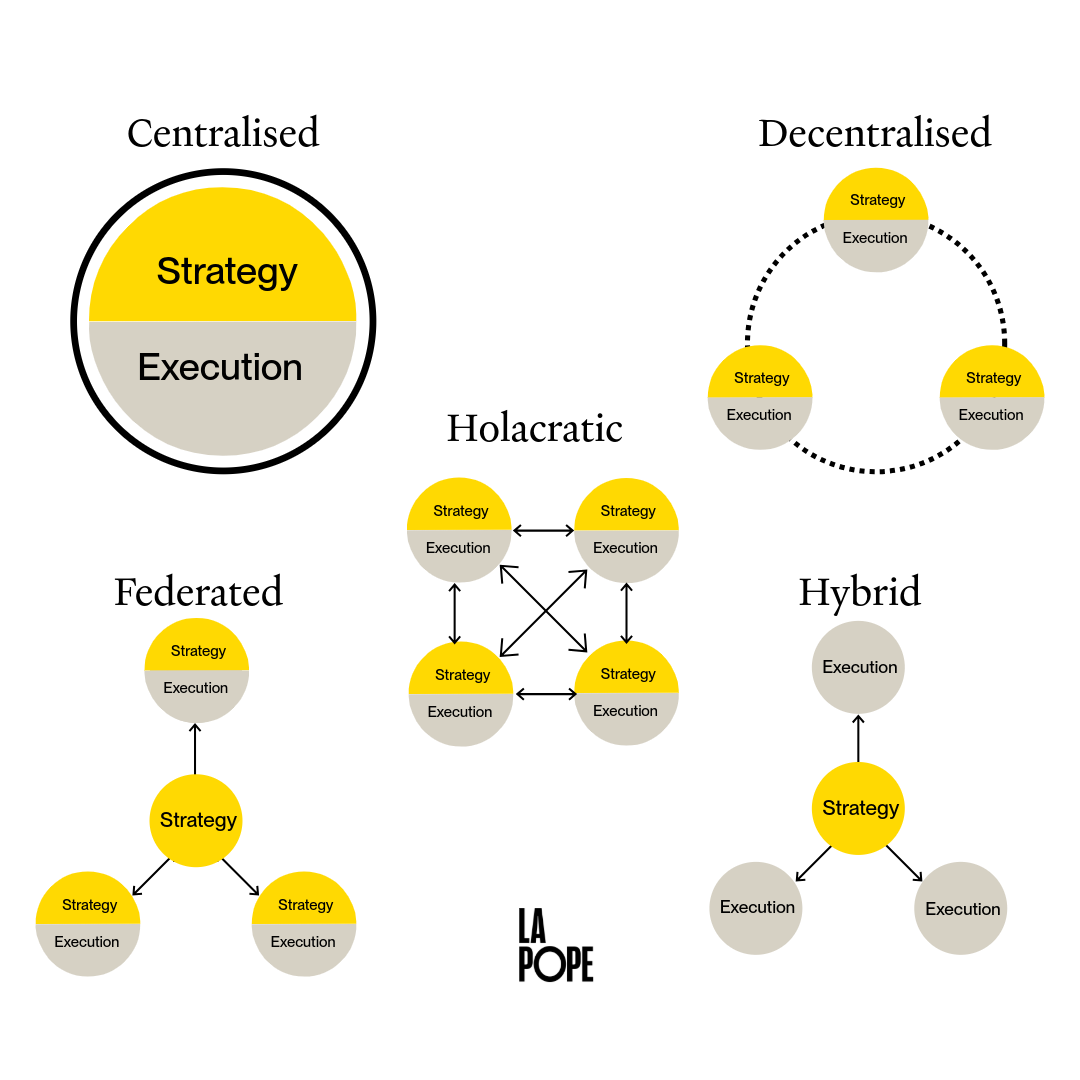
Image description
An infographic that displays five different models, each with a diagram illustrating the relationship between “Strategy” and “Execution” .
- Hybrid: A central, all-yellow “Strategy” circle connects down to three all-grey “Execution” circles, showing a central strategy directing multiple execution-only teams.
- Centralised: A single large circle is split horizontally, with the top half labeled “Strategy” and the bottom half “Execution,” showing a top-down structure.
- Decentralised: Three smaller, identical “Strategy/Execution” circles are arranged in a larger dotted circle, indicating independent units.
- Holocratic: Four “Strategy/Execution” circles are at the corners of a square, with arrows showing bidirectional communication between all units, representing an interconnected, non-hierarchical network.
- Federated: A central, all-yellow “Strategy” circle connects down to three smaller “Strategy/Execution” circles, showing a central strategy that guides semi-autonomous units.
Finding 1: Hybrid or hub and spoke is the most common organising structure
- 1 in 3 respondents say their organising structure is hybrid or hub and spoke, making it the most common approach
- 1 in 5 content teams are decentralised
- Holacratic is the least common organising structure
| What organising structure does your content team use? | Count | Percentage |
| Hybrid or hub and spoke | 24 | 34% |
| Decentralised | 14 | 20% |
| Federated | 10 | 14% |
| Centralised | 10 | 14% |
| Other | 8 | 11% |
| Holacratic | 5 | 7% |
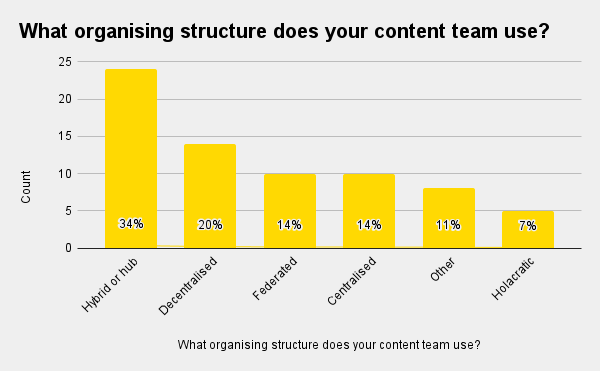
The ‘Other’ responses are mostly from respondents who say that their organisation had a mix of approaches. The most common answer is a mix of centralised and federated.
Finding 2: Smaller organisations are more likely to be centralised, larger ones to be decentralised
- Centralised structures are more common in smaller organisations
- Decentralised structures are more common in mid- to larger-sized organisations
| 11-50 employees | 51-200 employees | 201-500 employees | 501-1,000 employees | 1,001-5,000 employees | 5,001-10,000 employees | 10,001-50,000 employees | 50,001+ employees | |
| Centralised | 2 | 1 | 3 | 0 | 2 | 0 | 2 | 0 |
| Decentralised | 0 | 0 | 2 | 5 | 1 | 2 | 3 | 1 |
| Federated | 0 | 0 | 0 | 1 | 2 | 2 | 3 | 2 |
| Holacratic | 0 | 1 | 1 | 1 | 0 | 0 | 2 | 0 |
| Hybrid or hub and spoke | 2 | 3 | 2 | 6 | 4 | 1 | 2 | 4 |
| Other | 0 | 2 | 1 | 0 | 4 | 0 | 1 | 0 |
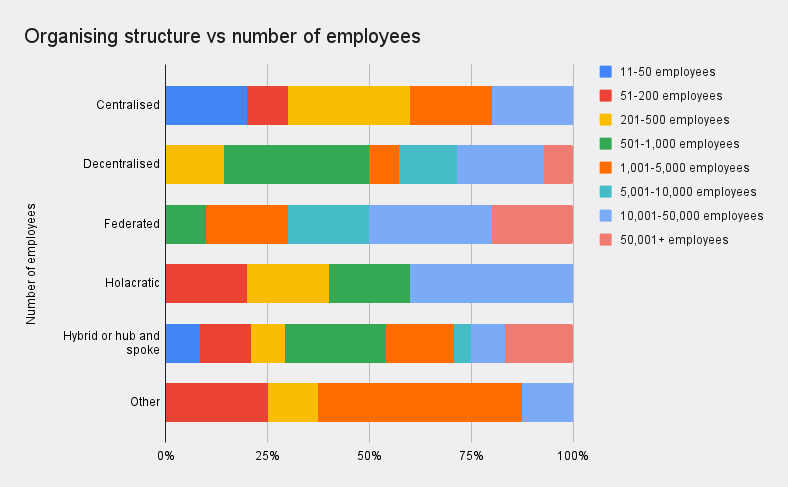
Centralised organising structures are most common among organisations with 500 employees or less. This makes sense. Centralised structures don’t lend themselves to larger organisations – having one team can quickly become a bottleneck, and it’s hard to respond to all the complex demands. (It was a surprise to see one participant report a centralised structure in an organisation with 10,001-50,000 employees. I’d love to ask them more questions about how this is working in practice.)
I had expected that centralised approaches would be more common. But given that respondents tended to be from larger organisations, it makes sense that it was less prevalent.
Decentralised structures were more common in mid- to larger-sized organisations. Again, this makes sense, because distributing responsibility for content strategy and production is pragmatic in larger organisations, However, it can lead to silos and inconsistent content, brand application, and user experience. I’ve not seen many examples of effective decentralised approaches, and to me, it feels synonymous with, and evidence of, a poor level of understanding of content. So seeing that 1 in 5 content teams are decentralised was a disappointing signal.
Hybrid or hub and spoke was the most common structure, and to me, this is an encouraging signal. In my experience, hybrid or hub and spoke can bring the best results for many organisations, because they offer a mix of central control to promote strong standards, with local flexibility for agility and scalability. However, other responses from the survey show that hybrid and hub and spoke aren’t working brilliantly for everyone. (More on that in a moment.)
Finding 3: Larger organisations don’t always have larger content teams
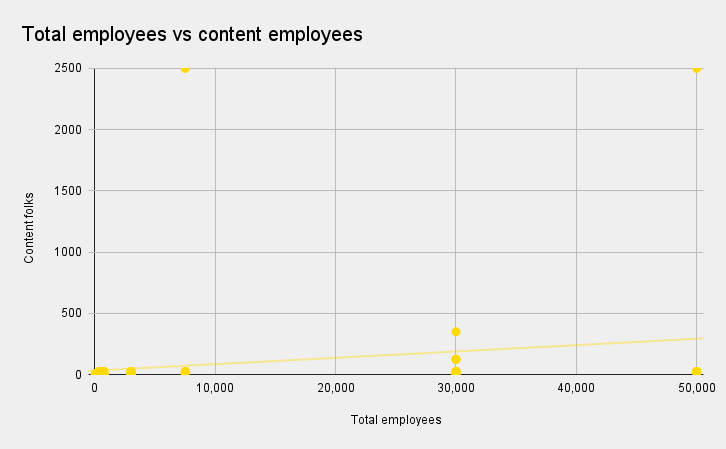
While this wasn’t the focus of the survey, it was interesting, so I’m including it anyway: there’s only a very weak positive correlation (0.2) between the number of content folks and the total employees in an organisation. So bigger organisations don’t always have more content people on staff.
This doesn’t surprise me, but it does make me feel a range of negative emotions about the ongoing struggle to get content teams the resources and headcount they need.
Finding 4: People don’t feel their organising structures are working well
- The most common score was 2 out of a possible 5. Almost 2 in 5 respondents gave this response.
- Only 1 respondent gave a score of 5.
| How well do you think your organising structure is working? | Count | Percentage |
| 1 = it’s not working at all | 8 | 11% |
| 2 | 26 | 37% |
| 3 | 25 | 35% |
| 4 | 11 | 15% |
| 5 = it’s perfect. | 1 | 1% |
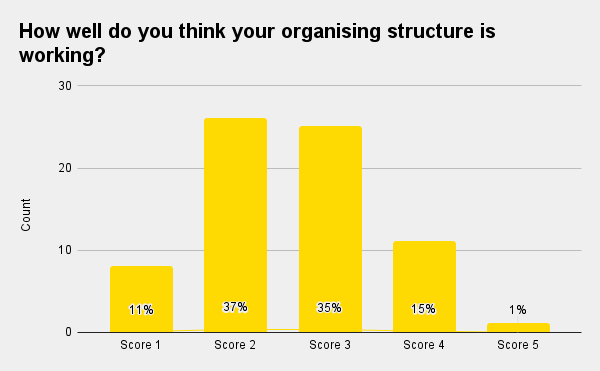
Overall, the respondents aren’t satisfied with the performance of their organising structure for content. Scores were mostly low – the average was 2.5 – and only a small number of participants chose 4 or 5.
When I looked at the explanations from people who gave their organising structure a positive score, these were the common themes.
What I heard from people who think their organising structure is working
- Strong processes and relationships: People talked about the importance of well-defined processes, effective communication, and strong working relationships with other teams and subject matter experts.
- Centralised standards and governance: Centralised standards and governance were frequently cited as a key factor for success, ensuring consistency and providing a strong foundation for content creation.
- Embedded content practitioners: Having content folks integrated into product teams, departments domains, where they are perceived as a valuable part of the team, fostering better collaboration and understanding of content needs.
“Our content designers are embedded in a domain, made up of multiple teams. Teams feel like Content Design is part of the team, so that’s working well.”
“We have empowered teams who come together to align for consistency and quality across all our brand comms. Plus, we create resources and guides for other teams to improve their content, or to create their own content that we can then optimize.”
“We are able to feel connected as a team but have ownership of our individual areas.”
Meanwhile among the explanations people who gave their organising structure a negative score, the common themes were as follows.
What I heard from people who do not think their organising structure is working
- Lack of authority and support: A significant issue was the content team having limited authority or support, or a lack of support or understanding from management
- Lack of strategy: A lack of strategy or agreement on priorities was a common complaint.
- Insufficient capacity and understaffing: Many teams reported being understaffed or having insufficient capacity to manage the volume of content requests, particularly when dealing with numerous non-expert content creators.
- Siloed work and lack of collaboration: A common problem was teams working in isolation, leading to duplicated efforts, inconsistent messaging, and a lack of knowledge sharing among content professionals.
- Resistance to standards and training: Some participants say they struggle to get people to stick to centralised standards.
“Central team operates mostly in an advisory capacity but has little to no real authority over content, particularly for devolved areas of the organisation. Content responsibility and authority in these areas is devolved to non-content professionals; either senior/long-standing staff or low-level administrators who are tasked with “web work” as a tiny part of their other, usually unrelated responsibilities.”
“The standards are centralised but getting people to adhere to those standards is difficult. Lack of digital knowledge from people who create content combined with it being a small part of their usually very large workload.”
“Elements of this work well but the problems come with lack of capacity across the organisation (there are not enough of us!) and differing skills across devolved content teams.”
Finding 5: There’s no single ‘best’ organising structure
- Centralised organising structures had the highest average performance score – 2.9
- Federated organising structures had the lowest average performance score – 2.1
| Organising structure | Average performance score |
| Centralised | 2.90 |
| Hybrid or hub and spoke | 2.79 |
| Other | 2.63 |
| Holacratic | 2.60 |
| Decentralised | 2.36 |
| Federated | 2.10 |
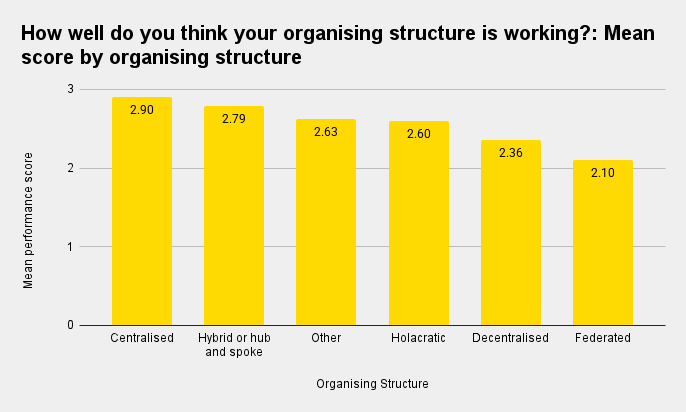
Looking at the average performance scores for the different organising structures, there’s not a huge difference between the highest (2.9) and lowest (2.1). It’s all very much in neutral territory. However, I think it’s still worth looking at the trends here.
Centralised and hybrid or hub and spoke were the highest rated. And I think this is likely to be related to the fact that both these approaches give a good opportunity to foster strong processes, a community of practice, and centralised standards and governance. These things matter to content teams, and play a big part in making successful content.
Centralised structures get the strongest rating overall. However, the average performance score for centralised structures declines as organisations get larger. Again, this tracks. A centralised approach is simple, straightforward, and can work very well in small organisations. But for larger, more complex organisations, it doesn’t offer enough flexibility, agility, and scalability.
Federated and decentralised being scored at the lower end of the scale also makes sense. These approaches do not offer the centralised control and elements of collaboration that matter to content folk and content impact.
Pros and cons of different organising structures
I collated all of the comments about different organising structures and pulled out the most common pros and cons for each one. Interestingly, the comments aligned pretty closely to the pros and cons outlined in my guide to organising structures.
Centralised
Pros:
- Creates a natural community of practic
- Good for small teams – it generally ‘works’
- Content is consistent
Cons:
- Capacity challenges – centralised teams can become a bottleneck
- Reactive focus over strategic
- Disconnect between content teams and the broader organisation
- Ownership of content strategy can be unclear
‘It’s the best choice for us as a small business, though it may not scale well as we grow.’
‘Strategy has actually over time been chipped away and given to other teams.’
“We’re over capacity, of course, but we have a consistent voice and patterns.’
Decentralised
Pros:
- Builds strong subject matter experience
- Builds strong relationships within the cross-functional teams
Cons:
- Content teams operate in disconnected silos and lack opportunities to collaborate and share knowledge, leading to duplicated work, lack of coordination, inconsistent content quality and standards
- Content folks lack clear authority and support systems to implement beneficial processes, with decisions often made without considering content impact.
‘We don’t have a centralized “content team.” Non-content people are creating content with no supervision or adherence to standards. Also, content gets created in silos, often without other teams’ knowledge.’
‘It works for the decentralised teams, as they feel they have control. But it is maddening for the digital team who look on with horror at the poor quality outputs.’
‘Not enough headcount and don’t really work with other content designers so it doesn’t feel like I am really part of any “team”’
‘Working in cross functional teams aligned to specific products helps us become SMEs in our functional areas and build strong relationships with our collaborators.’
Federated
Pros:
- Management are happy with the approach (but they don’t tend to see the issues with a federated approach)
Cons:
- Content is owned by and delegated to non-content professionals and administrative staff who handle content on the side, resulting in poor quality content
- Difficulty in enforcing content standards and guidelines. Templates and training are often ignored or superficially followed, and content teams struggle to ensure compliance without proper governance structures.
‘Central team operates mostly in an advisory capacity but has little to no real authority over content, particularly for devolved areas of the organisation.’
‘People tend to ignore the templates and the training. They do it just to get over it but don’t tend to apply it. This system only works if you have a team that does the governance.’
Hybrid or hub and spoke
Pros:
- Creates a sense of connection and a community of practice
- Hub and spoke approach promotes better subject matter expertise and relationships with SMEs
- Balance of strategic alignment on organisation-wide priorities and ability to focus on product/service-specific execution
- Centralised standards and governance promote consistency
Cons:
- Enforcing standards and governance can still be a challenge
- Hybrid approach can mean people are working across too many different things
- Departmental positioning and the power struggles between marketing/communications and product/service teams
‘The hybrid model ends up in a tussle between central Comms (where our role sits) and Product (where we work) over who ‘owns’ the content. It makes it almost impossible to do the job.’
‘We moved from a decentralised approach, which had developed due to a lack of guidance from earlier versions of the central digital content team, to a hub-and-spoke model. However, it has been challenging to ensure the spokes are aligned with the overall vision for the website. Many had been managing their areas independently for a long time, so shifting their approach has not been straightforward.’
‘I find that the only reason it’s working is that we have champions on each team who report to the “decision committee”. On teams where the champions are less engaged, or have a weaker motivation, this model tends to have its limits.’
‘We are able to feel connected as a team but have ownership of our individual areas. It can be hard to make time to discuss the work we’re doing and get feedback, but when we do it is highly valuable’
One observation I had about the responses on hybrid or hub and spoke approaches was that the issues were less to do with the fundamental qualities of the structure itself, and more about the challenges in operationalising it. These approaches don’t have the structural limitations of a central or decentralised approach, in terms of control or capacity. The negatives are all about the implementation and operationalisation. Hybrid or hub and spoke approaches aren’t a magic wand. They need strong leadership and communication, excellent relationships into different subject matter areas, and they need to be appropriately resourced to realise the benefits.
Finding 6: Levels of content capability are low
- More than half of respondents say their capability level is ‘Tactical’
- 1 in 5 say their capability level is ‘Reactive’ – the lowest level
- No participants say that they are the highest level of capability
| What level of content capability or maturity would you say your organisation has? | Count | Percentage |
| Reactive | 14 | 19.7% |
| Tactical | 38 | 53.5% |
| Strategic | 12 | 16.9% |
| Operationalised | 0 | 0.0% |
| Other | 7 | 9.9% |
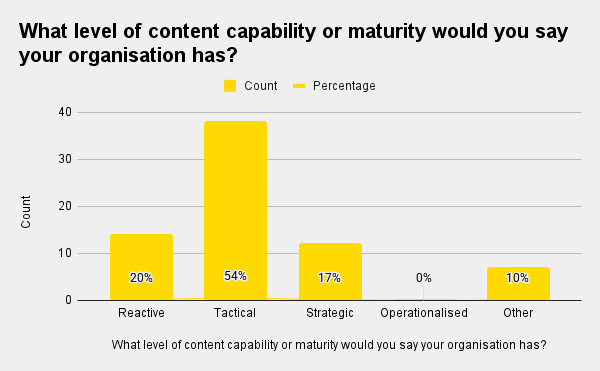
Capability level definitions
- Reactive: No forward planning. Ad hoc production and publishing. Ownership sits at a low-level. Focus is day-to-day, not strategic. Little or no measurement. Simple content in basic formats.
- Tactical: (Some) content planned in advance. Tactical understanding of how to use content. Senior stakeholder in place. Content siloed in different teams. Measurement is ad hoc and/or focused on reach. Content formats are more sophisticated.
- Strategic: Planning, production, measurement and distribution have a strategic foundation. Process and governance are established. Measurement is regular and insights feed improvements. Content is creative and engaging, and assets are reused.
- Operationalised: Content is seen as business-critical. Clear strategy in place that’s understood across the org. Focus on organisational/operational change to deliver better content. Content processes well-embedded. Investment in tech. Highly creative, engaging and innovative content. Content seen with a sophisticated omnichannel perspective.
In some ways, this was the most interesting section of the survey for me. 7 in 10 participants rated their capability as one of the two lowest levels: reactive or tactical. And no one who responded said that they were at an operationalised level. (Although a few participants mentioned that they are currently working towards this goal.)
Finding 7: Hybrid or hub and spoke teams have the highest capability
- Hybrid or hub and spoke teams rate their capability the highest on average
- Federated teams rate their capability the lowest on average
| What organising structure does your content team use? | Reactive (1) | Tactical (2) | Strategic (3) | Operationalised (4) | Other |
| Centralised | 1 | 6 | 2 | 0 | 1 |
| Decentralised | 4 | 9 | 0 | 0 | 1 |
| Federated | 4 | 4 | 1 | 0 | 1 |
| Holacratic | 1 | 1 | 2 | 0 | 1 |
| Hybrid or hub and spoke | 3 | 15 | 5 | 0 | 1 |
| Other | 1 | 3 | 2 | 0 | 2 |
| What organising structure does your content team use? | Average of What level of content capability or maturity would you say your organisation has? (Numerical) |
| Hybrid or hub and spoke | 2.0 |
| Centralised | 1.9 |
| Holacratic | 1.8 |
| Other | 1.6 |
| Decentralised | 1.6 |
| Federated | 1.5 |
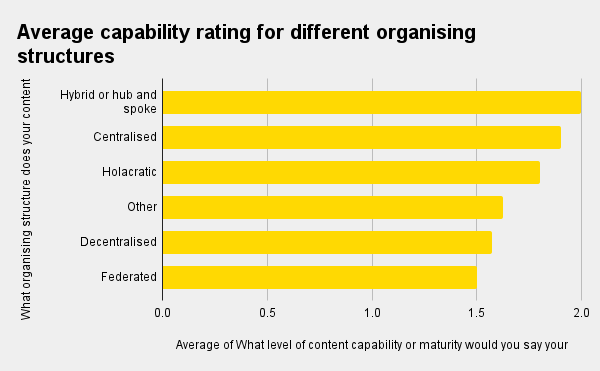
Hybrid or hub and spoke teams had the highest average capability rating of 2. But this still only puts them at an average ‘Tactical’ level.
This reflects the high level of challenge (and frustration) that I see so many teams dealing with as they try to increase their capability. Getting to the point where a team is operating at a truly strategic level takes a lot of hard work, so it’s not surprising that less than 2 in 10 participants rate themselves at that level.
Reaching an operationalised level is naturally an even bigger challenge. Before a team can get to this stage of capability, there are some big hurdles to clear. The survey responses indicate that some of the biggest challenges are around getting to the point where content is seen as business- or mission-critical, and breaking down silos between different parts of the organisation.
The takeaways
- Centralised structures can work for small organisations. If you’re a small organisation, with no plans to grow in the near future, a centralised organising structure may be a good choice. Small organisations tend to give centralised structures a higher performance rating. It’s a simple and straightforward approach and – provided you have enough people to meet demand – can run pretty smoothly.
- A hybrid or hub and spoke structure is likely to be best for larger or more complex organisations.If your organisation is mid to large in size or growing, hybrid/hub and spoke is worth considering (if it’s not your approach already). Hybrid or hub and spoke models are the most common overall and, importantly, are rated highest for performance and content capability. They offer a balance of central control for standards and local flexibility for agility, which is crucial to content success. But this comes with a caveat…
- Hybrid or hub and spoke structures need careful planning and implementation. Success for these approaches heavily relies on careful implementation, and not just on their inbuilt structural advantages. It’s not enough to just adopt the structure itself – you need to make sure the processes, relationships, and governance are there to back it up.
- Decentralised structures lack key enablers for content success. Decentralised structures are a challenging environment to produce effective content in. Without some kind of centralisation, there’s a high likelihood of silos between products/services, inconsistent or low quality content, and risk to the strength of the brand overall. Plus, content professionals can lack the community of practice they need. If leaders in your organisation can’t see the challenges for content with a decentralised approach, it may be worth investing time and effort into trying to influence this.
- Implement some kind of centralised content guidance. No matter the structure, implementing some kind of centralised content guidance or leadership is likely to have benefits. This might be a guiding content strategy, a set of guidelines, a community of practice, or something else, but having something that connects everyone working on content has the potential to make a difference.
- Always consider capacity and organising structure together. Many participants said that being understaffed was a significant challenge. If you can’t meet demand, changing your organising structure might help to alleviate the pressure – but you’ll have to think about reducing your remit at the same time. Increasing your headcount or capacity might be a better way to go, if the organising structure is well suited to your organisation. I realise that increasing headcount isn’t an easy thing to do for many content teams, but there might be other ways to approach increasing capacity, like working with external partners, or devolving responsibility for some content.
- Remember the key enablers for strong content. The survey showed a few key enablers for strong content – basics that I’m sure won’t be a surprise to anyone.
- Processes and workflows: Look at processes for your common pressure points like decision-making, prioritisation, and feedback/approval
- Guidelines and adherence: Create useful guidelines to promote content consistency and quality, and take the time to make sure people understand them and use them
- Relationships: Aim to strengthen working relationships between the content team and stakeholders, including subject matter experts, marketing, communications, and product teams
- Knowledge sharing: Try to break down silos and encourage collaboration and knowledge sharing among content professionals. This could include communities of practice or regular cross-team meetings.
What’s next?
This report left me with some questions that I’d like to dig into in more depth:
- What are the nuances of organising structures when it comes to different kinds of content and content roles, for example product content/content design vs content strategy and advice and information content?
- What organising structures are being used in content teams at the top of the game? (Those sitting at an operationalised level of capability.)
- What difference does ownership/location of content make to how people rate the performance of their team? (By this I mean the directorate, or department that content is part of.)
- What’s the impact when a content team doesn’t have any strategic control? When strategy is set by another team for them to follow?
If you have thoughts or ideas to share, I’d love to chat – so get in touch.
Related resources

Organising structures for content teams: a guide

Understanding your content team’s capability