
Case study

The brief
Samaritans wanted to update its brand voice as part of a wider brand refresh. The goal was to help it reach a wider, more diverse audience — without losing the warmth and trust it had built over decades.
The challenge wasn’t just writing good guidelines. It was finding a voice that could do a lot of different jobs: support someone who’s struggling to cope, motivate a fundraiser, persuade a policy maker, and thank a volunteer — and feel consistent across all of them.
The approach
The project ran over about two months, and covered four phases: discovery, a collaborative workshop, writing the guidelines, and training. I worked in partnership with the brilliant Paul Allen from Lark.
Discovery
Before putting pen to paper, I needed to understand the full picture: the brand refresh strategy, what the existing voice guidelines said, who’d be using the new guidelines day-to-day, and the range of audiences Samaritans communicates with.
Samaritans talks to a remarkably broad set of people. Someone calling in crisis has completely different needs from a major donor, a journalist, or a corporate partner. Any voice framework would need to hold up across all of them.
The workshop
Paul and I ran a collaborative workshop with staff from across the organisation. This wasn’t just a box-ticking exercise — getting the right people in the room was essential to making sure the guidelines reflected the full breadth of what Samaritans does, and to building buy-in from the people who’d be using them.
One of the things I remember most clearly from the workshop was a simple warm-up exercise: I asked participants to think of a public figure or fictional character who they felt embodied the Samaritans personality. The answers told a story. Early on, people reached for cosy, familiar, kindly national treasures — figures who felt safe and warm, but not particularly bold. By the end of the session, something had shifted. The room had moved toward something more confident and empowering, while still holding onto that essential sense of care. Watching that shift happen in real time was one of those moments that makes a workshop feel almost magical.
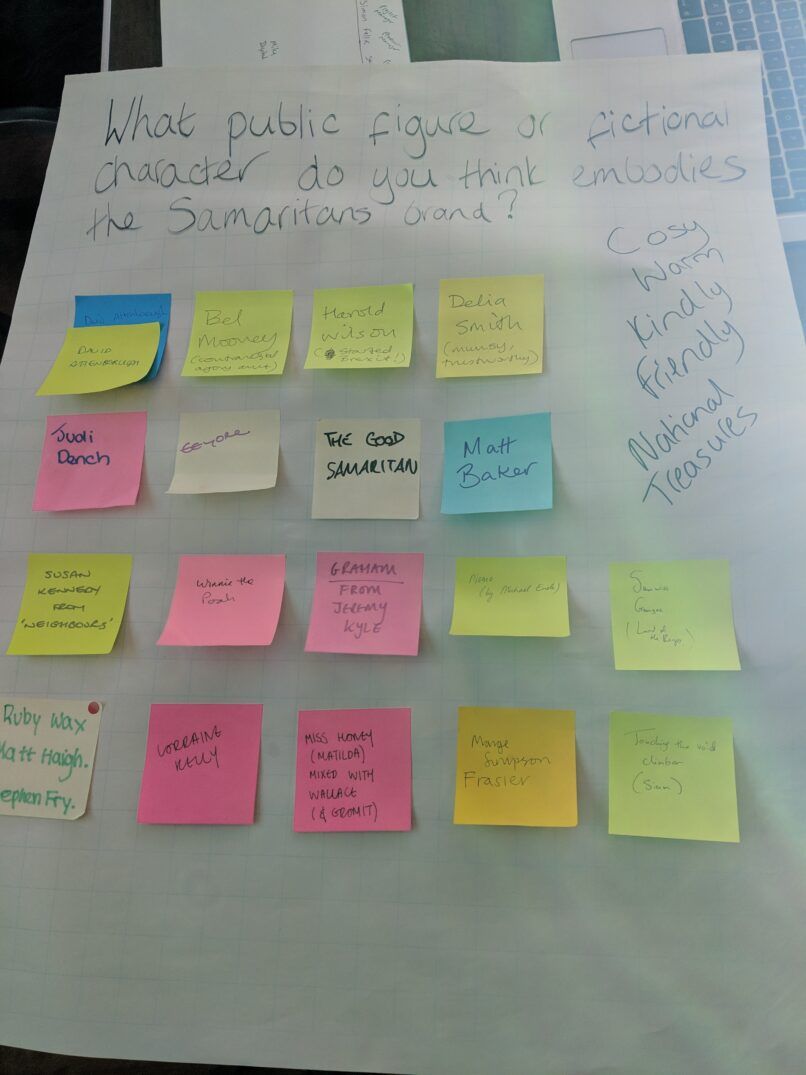
The exercise helped us land on a framework built around four personality traits: Confident, Approachable, Real, and Empowering — or CARE. The idea was that each trait had equal weight, and together they described a voice that could feel warm without being soft, and authoritative without being cold.
The guidelines
The guidelines I wrote distinguished between two things: personality and tone.
Personality is constant. It’s who Samaritans is in every piece of communication. The CARE framework captures this.
Tone is flexible. It’s how the voice shifts depending on who you’re speaking to and what you need to achieve. We defined four main tones — Collaborating, Motivating, Supporting, and Thanking — each with guidance on when to use it, how the voice shifts, and worked examples to make it concrete.
The goal was to give anyone in the organisation — not just the marketing team — a framework they could actually use, without having to read a 40-page document first.
Training
I ran training sessions for staff across the organisation to help them understand and start using the new voice. The feedback was encouraging: some attendees said they were going to apply what they’d learnt that same day.
The outcome
The brand refresh launched to a positive response. The early metrics from the weeks following launch were striking:
- Logo recognition reached 47% — the highest in over two years
- Social media reach grew by 42%, from 3.8 million in February 2019 to 5.4 million in March 2019
- Website revenue increased by 124%
- 90% of branches used the new brand centre to order materials
- Volunteers rated the updated brand 4.13 out of 5
- The income generation team reported an increase in companies approaching Samaritans about partnership work, which they attributed in part to the more modern and professional brand presentation
None of those outcomes are down to the voice guidelines alone — brand refresh is a team effort, and Samaritans had strong work happening across design, digital, and communications simultaneously. But a voice that gives everyone in the organisation a shared way of speaking is part of what makes a rebrand hold together.
If you’re working on a brand voice project for a charity or nonprofit, get in touch to talk about how I can help.
Published: 20th July 2019