
Guide

What is content strategy?
Before we get into anything more complex, let’s start with a definition.
Content strategy is planning for the creation, delivery, and governance of useful, usable content.
Kristina Halvorson
This definition comes from Kristina Halvorson’s Content Strategy for the Web. I like this definition because it highlights that content strategy is about the why and the how, rather than just the what.
If you don’t know why you’re creating the content or how you’re going to do it, your content is ad hoc, not strategic. And that means that it’s probably not going to drive as much value as it could. This is important for charities, where there’s pressure to be as effective and efficient as possible.
What a content strategy should include
Content Strategy for the Web has a model that explains what goes into a content strategy — the Content Strategy Quad — which I find really useful.
It breaks a content strategy into two main parts: the content elements, and the people elements. It makes a great basis for thinking about what to include in your content strategy.
1. Content
1a. Substance
The kinds of content you’ll create and the messages it will share. This includes:
- Topics: the subject matter your content will cover
- Content types: the different kinds and formats of content you’ll create
- Sources: where you’re going to get your content from
1b. Structure
How content is prioritised, organised, formatted and displayed. This includes:
- Information architecture: how content is organised, structured, and labelled on your website
- Content modelling: a document that defines all of your content types, breaks them down into the granular parts, and captures the relationships between them.
2. People
2a. Workflow
How you’ll go about creating your content. This includes:
- Processes: for each step of the content lifecyle
- Tools and/or platforms: where you’ll do the work/use to help with the work
- People and roles: who will do what
2b. Governance
How you make and communicate decisions. This includes:
- Policies: the big ideas or pillars at the heart of your content strategy.
- Principles: the ideals and ways of working you want to uphold.
Why content strategy matters to charities
Now that we’re clear on what it is, let’s talk about why content strategy is relevant to nonprofits and worth spending time and effort on.
When content is underpinned by a solid content strategy, it will be:
- purposeful and well-planned out
- user-focused
- consistent and high-quality
- produced and managed in an efficient way
- aligned to your organisation’s goals
And that creates a better experience for users and makes a positive contribution to the organisation overall.
Content strategy for different types of charity
Content strategy is useful for all charities, no matter what area you focus on or sector you’re in. This includes fundraising, service delivery, campaigns, and anything else you can think of.
Fundraising and donations
Content strategy can support your fundraising efforts by:
- Creating visibility and awareness of your organisation among your target audience
- Giving people a clear understanding of the mission of the charity, and building support
- Building a better user journey towards donation through your content types and content model
Service delivery
Content strategy can support online and offline service delivery by:
- Creating visibility and awareness of the service
- Helping people access the service, by answering their questions, providing practical information they need, and helping to build a sense of trust and credibility
And for digital services, content strategy (and content design) is crucial for making sure that the service is useful, usable, and accessible.
Read more about the role of content in service delivery.
Education, information, and advice
If you provide education, information, or advice on your website, content strategy is vital. It will make sure that:
- Users can find and navigate to information
- Content reflects user needs (and not just what the organisation wants to say)
- Information is consistent and high-quality
- Information is readable and accessible
- Content is regularly updated
Campaigns
If you need to generate support for a campaign, a content strategy can help by:
- Making sure you’re reaching the right audience, with the right message, in the right place and time
- Providing a framework for ‘in-flight’ campaign analysis and iteration
Tips for charity content strategy
‘Know who you are and do it on purpose’
To paraphrase Dolly Parton: know who your charity is and act on that with intention. By that, I mean getting a precise understanding of:
- What your organisation does
- Why it does what it does
- How it’s different
Your strategy should be specific to your organisation, and this is a key part of achieving that.
This can be a pain point for many nonprofits. Getting to this level of precision is tough. If you work in a larger organisation with a brand team, you should probably be getting this from them. And if you don’t feel like what they’re giving you is enough, that can create friction. If you work in a smaller organisation, you might need to define this yourself or collaborate with others to do so.
Work from the organisation’s strategic goals
The content strategy’s job is to help the charity achieve its goals. So you need to have them in mind as you write your strategy, and be able to show how your recommendations ladder up to them. This is key to an effective strategy (and getting buy-in for it).
Collaborate on your strategy
Collaborate with your stakeholders to create a content strategy. Ask about their challenges and opportunities, and how what they do relates to your content. You must also explain your strategy, the rationale, how it affects them, and how it benefits them, too.
Understand your users
A content strategy is about finding what unites your users and your organisation. This sweet spot is where you get the best return for the lowest effort. To find it, you need to understand your audience: who they are, what they need, what they care about, and how they behave. If you don’t know this stuff, start by finding out.
You do not need multiple strategies for different types of user
Charities often speak to distinct audiences, like the people who use their services, supporters, volunteers, commissioners, corporate partners. A question I hear a lot is ‘do charities need to create a different content strategy for each user group?’
I think it’s best to have one content strategy for all your audiences. It needs to unite everything you’re doing, look at the big picture, and promote consistency. If you have multiple strategies, you risk things getting fractured, complicated, and duplicating effort.
This doesn’t mean you should produce the same content for every audience. You can use the substance, the messaging, the content types, etc within your strategy to provide guidelines on how to reach each different audience.
Don’t assume the content types you need
It’s easy to get drawn in by the siren call of the latest cool content format, or assume you need a certain content type because everyone does it.
There’s nothing wrong with putting these things on your ideas list. But you should analyse whether they’re what your users need and will contribute to your organisation’s goals. For example, blogs are a popular content format and easy to implement. But do you have enough time to write new posts every week, and does this format get the right message to the right person at the right time? Or TikTok: it’s huge right now, but are your users actually on there? Do you have the capability to create the content that works for the channel?
Do less, do it brilliantly
Time and capacity seem to be a huge struggle for content people in all charities, irrespective of size. There’s so much to do, so little time, and so many people saying, ‘Can you just…?’.
The answer isn’t to create a strategy that tries to do it all. That’s unrealistic. And it’s probably ineffective too: trying to be everything to everyone is often a sign of a bad strategy.
The answer is to create a strategy that focuses on doing the most impactful things in the most efficient way. There’s no shame in doing less. Doing a few things brilliantly is something to take huge pride in, and is likely to have a big impact for your charity, too.
Process and people are essential
Don’t skip the ‘People’ side of your content strategy. You need to map out who is going to do what, when, where, and how. Strategy starts with a document, but success is all in the doing. Your strategy needs to be a part of your day-to-day: informing what you do and how you do it, all the time.
The key takeaways
- Content strategy is about careful planning for what content to create, how to deliver it, and why it matters. Focus on the ‘why’ and ‘how’ to create meaningful impact.
- Rather than creating multiple strategies for different audiences, have one cohesive content strategy. It promotes consistency and avoids complications, ensuring a clear message.
- Understanding users’ needs is paramount.
- Quality triumphs over quantity. Focus on a few impactful initiatives and execute them brilliantly, rather than spreading resources thin. Focusing on efficiency maximises the impact of content efforts.
- A content strategy shouldn’t just be a document; it should be integrated into daily operations. Collaboration, clear roles, and understanding how the strategy translates into action are essential for success.
If you’d like to talk about content strategy for your charity, get in touch. No obligation – I’m always happy to offer advice and be a sounding board.
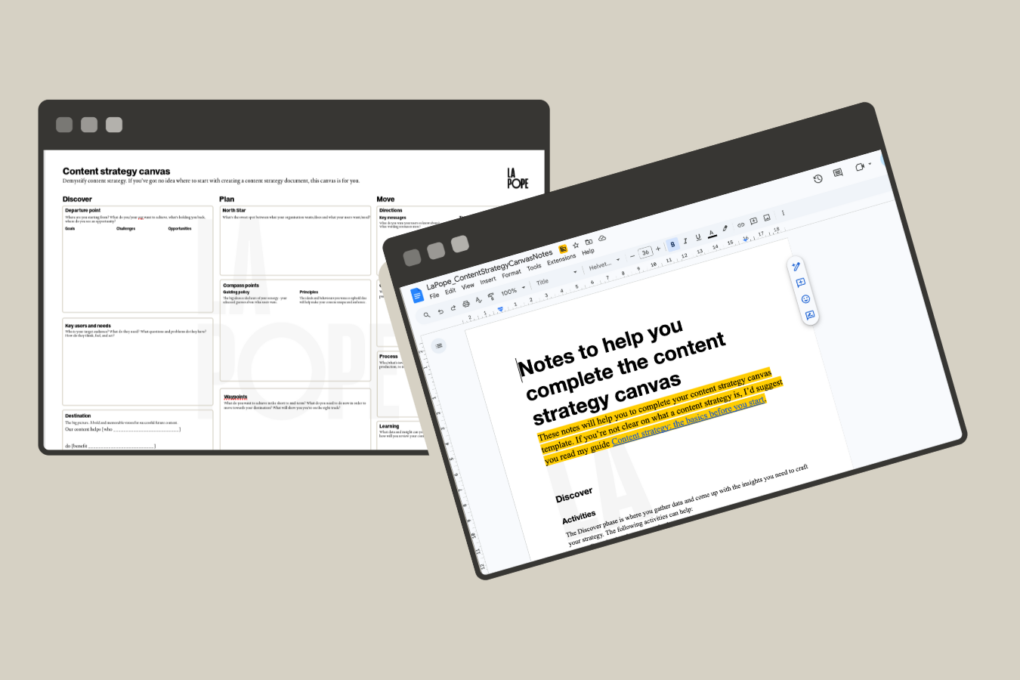
Content strategy canvas
First published: 13th October 2023
Last reviewed April 2026