
Guide

You’ve got your content strategy nailed. You know your users and what they need from you. You know your organisational goals. You’ve mapped out the perfect content pillars to bring those two things together. You’ve got a vision for your team and your content, and you’ve come up with the key policies to get you there. You’re doing it all by the book, but somehow, you’re still not making any progress.
You’re spending ages on admin, stakeholder wrangling, and going backwards and forwards on briefs. You can’t seem to publish on time. You have no idea whether your team is under capacity or over capacity. You’re doing everything from scratch every time.
If any of that sounds familiar, you might have a content operations problem. This guide will help you understand what content ops is, and how to start improving your approach.
What is content operations?
Content operations is the ‘how’ of content in your organisation. It’s the processes and workflows that you follow and the tools and systems you use to produce content to a high standard, day in, day out.
Content operations vs content management
Content management is about the tools/systems that hold your content. Content operations is the broader system of people, process and tools that gets content made and managed.
Content operations vs content strategy
I often remind clients that a content strategy isn’t a document, it’s the things they say and do and choose every day in relation to content. And if a content strategy is there to provide direction on what to do, then content operations is how you go about doing it in practice.
To use an analogy, it’s like the Sisyphean task of feeding your household (Side note, is it just me, or does anyone else feel aggrieved every time they realise they’re going to have to work out what to eat every day for the rest of their life?):
The content strategy part is the goals we set and big choices we make:
- Destination: Three meals per day of food that is healthy and tasty
- Key policies: Vegetarian for ethical reasons, costing less than £100 a week for practical reasons, must be quick to cook and not use every pot in the kitchen for energy reasons
- Governance: Shopping is my responsibility, washing up is my partner’s, we’re responsible for our own breakfast and lunch, but I cook dinner.
Read an introduction to content strategy.
The content operations part is the processes and tools we follow and use to make this happen:
- An ongoing shopping list we add things to when we run out
- A weekly summit where we decide what to eat next week and write a list
- A weekly shopping trip to buy ingredients
- Recipe books for inspo
- All necessary kitchen equipment available and maintained
Why content operations matters
What I think the analogy with feeding your household highlights is that content ops is vital to the success of content teams. Without ops, you can still reach the strategic destination, but it will be slower, harder, and less efficient.
Getting your content ops right has some key benefits:
- Efficiency: Focusing on building effective processes and giving your team access to the right frameworks, knowledge and tools will streamline your workflow. And that can help you get more work/better work done with less investment of time or effort.
- Impact and ROI: Content ops can help you put the guardrails in place to keep your content focused on impact, and help you prioritise higher-value activities.
- Alignment and collaboration: It can help you break down silos between teams and realise a more collaborative, integrated approach.
- Quality and consistency: It can help you maintain standards (and reduce risk), for a more consistent, unified experience.
- Scalability: Content ops are the foundation for a scalable approach to content that can keep up with increasing demand
The 2025 State of Content Ops report from Content Science found a strong correlation between content operations maturity and content success. 80% of the extremely successful and nearly 70% of the very successful operate at maturity levels 4 and 5. Read the state of content ops report. (Sign up required – free.)
Components of a content operations framework
The main components of a content ops framework are: alignment and collaboration, process and workflow, and platforms and tools. These things are very interwoven, and hide a lot of complexity. I’ve tried to unpack this in the rest of this section.
Remember that what your content ops framework should include depends on the size and purpose of your team. What’s essential for a content team of 40 might be less important for one of 4. What a team that creates assets for reuse needs, will look different to one that owns a channel.
Alignment and collaboration
How you collaborate and communicate within the content teams and with stakeholders and leaders, including:
- Project teams/governance groups: the cross-functional teams and groups that content needs to be part of
- Meetings: what meetings you run, and what meetings you need to attend
- Comms channels: the comms channels – like email, Slack, Teams – you use and what role they play in collaboration and alignment
Read a guide to facilitating good workshops and meetings.
Process and workflow
A granular view of the specific stages and steps that your content needs to go through across its whole lifecycle. The stages in the end-to-end process vary a lot by team, but might include:
- Requests, intake, briefing: how content starts life, how people engage the content team, how the content team can suggest ideas and projects itself
- Planning and prioritisation: how you decide what to do and when, how you decide what’s the most important or best thing to spend your time on
- Content creation: how you go about creating your content, the research you do first, how you approach outlining or drafting
- Feedback and sign off: how you get feedback from stakeholders in an effective way, what you’re actually asking stakeholders for feedback on and why
- Publication and distribution: how and where you publish, share and amplify your content
- Measurement: how and when you measure the performance and impact of content
- Iteration: how and when you iterate, refine and improve content throughout its lifecycle
- Archiving and deleting: how and when you decide to archive or delete content
Read a guide to prioritising content work.
Platforms and tools
The tools and technology that you use across the content lifecycle and to help with planning, alignment and collaboration. For example:
- Work management tools: A system like Trello, Monday, ClickUp, Asana, to track tasks, progress and capacity
- Research: sources of data, insight and information and/or how you share your data and insight with others
- Assets and media: how you store and share content, assets and other media for reuse
- Content creation: things that help you create content, like Google Docs, Grammarly, Writer, Canva, etc.
- Measurement and reporting: like Google Analytics, or user feedback tools
- Templates and frameworks: templates and frameworks that help people to be more consistent and create more high quality outputs, like templates for different content types
- Guidance and policies: the guidelines and rules that people should follow for high quality content, like accessibility guidelines, or a style guide
- Checklists and acceptance criteria: the boxes something must tick in order to be published
A note on governance and content ops: Content ops is very dependent on having a solid governance structure in place, so that you know who is responsible for what. Your content strategy should set your content governance approach, and your operations approach should execute and apply it.
Who should be responsible for content ops
In my experience, ops is usually part of the remit of whoever leads the content team. While it might not be explicitly mentioned in the job description, it’s often the expectation that whoever leads the team will be looking after the processes and workflows too.
In larger teams, this can become a dedicated role – a content operations manager or content ops lead. If you’re a head of content that’s struggling to find the time for ops, or you don’t have the skills, it could be worth investigating if a dedicated content ops role would be a good addition to the team.
How to create a content ops framework
When people don’t know how something works they make it up
Lou Downe, Good Services
It can be helpful to think about creating your content operations framework as a kind of service design. As Lou Downe says in Good Services, when people don’t know how they’re supposed to do something, they’ll come up with their own way. Your content service should consider the needs of both your team and your stakeholders, and the experience they will have throughout. And to quote Lou again ‘the service should encourage safe, productive behaviours from users and staff that are mutually beneficial’.
When I’m designing an ops framework for a client, there will typically be a big map where I look at the overarching process, and then a series of documents where I work out the fine details. But this is all just a precursor to implementation, which is what really matters. The ultimate deliverable for your content ops framework is things like:
- Booking in meetings, inviting the right people, setting the agenda, facilitating and managing the actions
- Sending out comms and managing channels and conversations
- Setting up your intake process and managing the requests
- Structuring, setting up and using your work management system
- Automating workflows in the CMS or work management tool (more on that in a moment)
A service level agreement (SLA) might also be one of the ways that you can document and demonstrate your content ops framework. Read the guide to service level agreements for content teams for more on this.
AI and automation in content operations
Content operations is a key area where AI and automation have the potential to support overworked and under-pressure teams. The same Content Science report I cited earlier found that in 2025 86% of those polled were using AI in some content ops capacity, up from 29% in 2023.
I’m interested in the potential, because there’s a lot of repetitive admin work here. And compared with other areas of content work, ops work feels less risky and less ethically questionable to outsource to AI.
Some content ops tasks that might lend themselves to AI and automation include:
- Automating parts of your workflow/approval:
- Sending out AI-generated meeting notes and actions to participants
- Sending notifications to owners when content is due for review
- Retiring content at the end of its life
- Transcription
- Producing summaries
- Tagging and categorising content
- Writing meta data
- Checking content against guidelines
This will all require a human to check and approve the outputs, but it can still save a lot of time. It’s a compromise: in an ideal world you’d have the time and resources to do it all, but you don’t, so look for the repetitive tasks that are either low-skilled or can be codified.
There are some case studies coming through on what teams are achieving by doing this.
Department for Business and Trade
At a User Behaviour and AI Learning Group meet up, the team from the Department for Business and Trade shared how they use a tool called CART – Content Audit and Red Flagging Tool – to audit large volumes of GOV.UK content and flag pages or files that need to be reviewed or removed. The tool (which is not AI) looks at freshness, user relevance and accessibility/usability to flag pages, which are then reviewed by a human. Watch a recording of the meetup.
Storyblok
Stoyblok shared a case study on how it uses AI to reduce content debt. The team implemented a system of automated triggers for content lifecycle management. For example, event pages are automatically retired one year after publication, and articles are flagged if no one visits for six months. Read the Storyblok case study.
Calyx
Calyx uses AI to manage content debt and produce content templates. They use AI to identify outdated ownership and product names, and surface underperforming assets, which are then validated by a person. They also built a generative AI/NLP assistant in Copilot to analyse high-performing content and generate templates from it. Read the Calyx case study.
In conclusion: content operations puts dinner on the table
To bring us back to the analogy we started with about feeding your household: even with the best strategy and intentions, dinner still won’t appear unless someone’s doing the shopping, running the summit, keeping the kitchen stocked. That’s the case for content operations. It’s what actually gets dinner on the table every night.
If you’re ready to try and convince your boss to invest, you may want to read How to make the business case for content operations.
Content operations reading list
Leading Content Design, Rachel McConnell
Getting started with content operations, Rachel McConnell ,
What are content operations and why are they important?, Shelter
Content operations: the hidden superpower of digital delivery, Shelter
What Is the State of Content Operations in 2025?, Content Science
What Is Content Operations?, Content Science
AI Content Operations: A 30-Day Implementation Guide, Sanity
Related resources
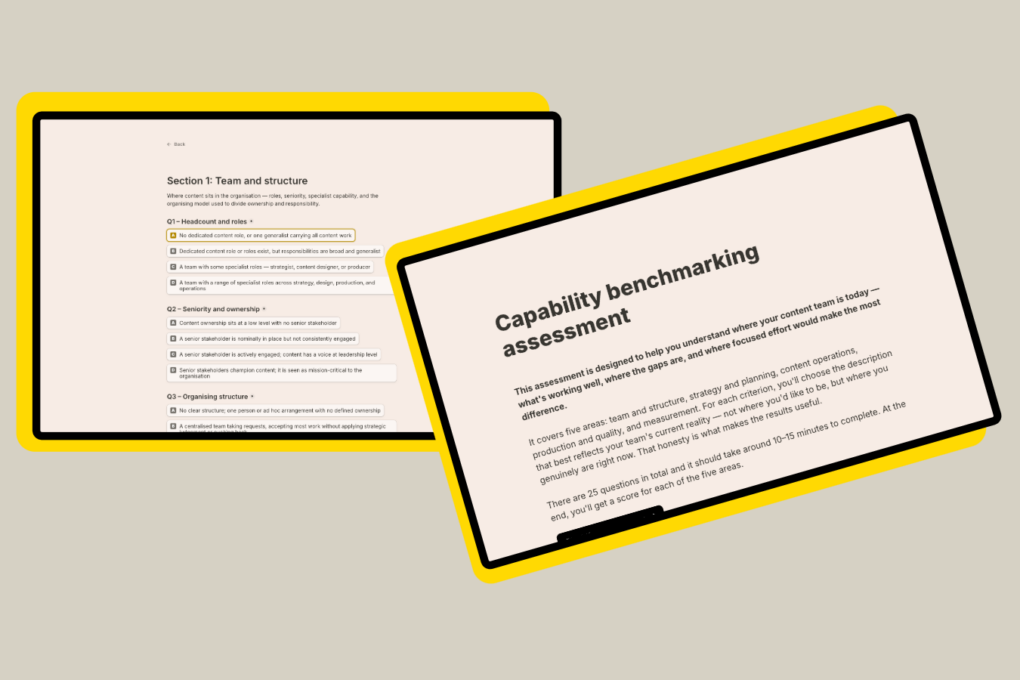
Content capability assessment

How to make the business case for content operations