
Guide

You’re convinced. You’ve read the guide to content ops, you can see the gaps in your process, and you know it isn’t a nice-to-have — it’s what turns a good strategy into a system that can produce content to a high standard, day in, day out.
But your leadership doesn’t know any of that yet. And ‘we need better processes’ is rarely a sentence that gets budget released or headcount approved on its own. (Trust me – I’ve tried, and failed.) Here’s some tips on how to build a pitch that lands from someone that’s sold content operations projects to clients and their bosses.
Use positions versus interests
Treat this like a content design exercise and make sure you create the content of your pitch based on the user needs. (Your boss is a user in this scenario.) Before any pitch, map out what your stakeholders’ positions are (the things they are always saying/emphasising) versus their underlying interests (what actually motivates them). Look for the overlap between their interests and yours, and build your messaging around that overlap. (Credit to Sara Wachter-Boettcher for introducing me to this model at Throughline conference.)
Frame it as an enabling role, not overhead
Position content ops as something that can free up capacity, rather than an added cost. Look at your current process and workflow, and where the sticking points are. Will investing in content ops free up production time, leadership time, or something else? And what opportunities will that open? Will it mean you can produce more content, clear a backlog, take on more strategic and impactful work?
You could make the case that growing a team without solid content ops in place first increases the risk of inefficiency and ‘leakage’ — ops is what makes future growth sustainable. It’s essential for bigger teams, not a nice-to-have.
Another angle is that ops work can open the door to better usage data and measurement, which becomes valuable evidence for other areas too, not just for the ops role itself.
Bring evidence, not just opinion
Use a maturity or capability benchmarking assessment to understand your current state. Showing that you’re underperforming using an independent framework can provide compelling, concrete evidence of a gap. Some bosses need external validation as part of their decision making. I have a free capability assessment you can use: take the content capability assessment.
Where possible, point to what a lack of ops is already costing: chaotic intake, distractions, inconsistency, duplicated effort, or whatever the case is for your unique situation. Concrete before/after examples land better than a general case for ‘better processes’.
Keep the case business-led, not person-led
Even if content ops is a great development opportunity for a specific person, or would benefit specific members of the team by improving their experience, don’t lead with that. Some bosses will be resistant to shaping roles around individuals, and this can undermine an otherwise strong proposal. Keep individual development and benefits as something you recognise and support internally, separate from the pitch you take upward. (The exception to this would be if you know this is a key concern for your leadership.)
Address the ‘who does this’ resistance directly
Anticipate the objection that ops ‘should just be absorbed’ into existing roles. Be ready to name specifically what isn’t getting done today because no one owns it (Trello boards not kept current, requests with no formal route in, web content maintenance with no clear owner, for example).
If you want to evolve an existing role rather than hire, show how the change matches shifting realities of the work (less production churn, more capacity), rather than framing it only as a cost-saving move
Match the ask to your organisation’s culture
Adjust tone to the culture you’re selling into. If you’re in a process-light, relationship-driven organisation, avoid framing ops as rules and enforcement. Instead, frame it instead as clarity, consistency and calm, and a collaborative way of upholding standards rather than a rigid or ‘red flag’ approach. Consistency delivered quietly and collaboratively is often more persuasive, and more sustainable, than a hard push for compliance.
Lean into the AI moment
Rightly or wrongly, AI can be an attention-grabber at the moment, so if it’s relevant, link your business case to it. Anxiety about AI can work in your favour: leaders who wouldn’t otherwise engage with process arguments will pay attention when the framing is ‘this is how we can use AI in content ops to improve’. There are real applications for AI within content ops itself (workflow automation, audit tools, tagging), which is a current and credible thread to pull into a proposal.
Bringing it all together: treat it as content design
Every tactic above comes back to the same principle: treat the business case for content operations as a content design exercise, and your leadership as the user. That means starting with their interests, not your own frustration with the current process. It means bringing evidence they’ll trust, not just your own conviction. And it means framing the ask in the language of capacity and risk, because that’s usually what leadership is actually listening for, even when the conversation is nominally about workflows and templates.
If you take one thing from this: don’t lead with what’s broken. Lead with what becomes possible once it’s fixed.
Related resources
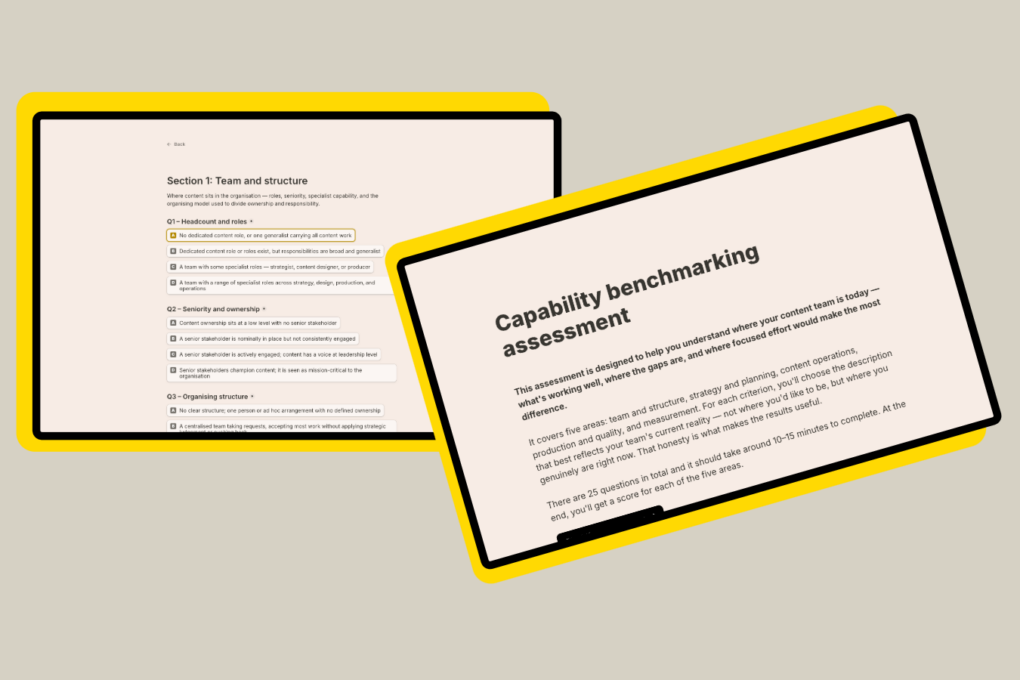
Content capability assessment

Content operations: what it is and how to get it right