
Report30th September 2026

See the research questions
- Are charities seeing a fall in organic search traffic because people are finding the information they need from their search engine results page (for example Google’s AI Overviews) or in chats with generative AI tools (like ChatGPT and Gemini)?
- Is there anything different about the traffic coming from AI sources?
- Are AI search and generative AI tools leading to misinformation?
- Are charities changing their content strategy as a result, and if so, how?
Organic search traffic is declining and this is attributed to AI
39%
of have seen a decrease in organic search traffic over the last 12-18 months which they attribute to AI Overviews/AI search.
- Only 20% said that they had seen no decrease.
- Respondents reported declines of between 4 and 40% at the extremes, but most responses clustered between 10% and 25%.
- 80% see AI search as a risk to reach for their organisation (25% major, 41% moderate).
AI-driven traffic shows different patterns
- Respondents are seeing changes in user behaviour in the traffic coming to their websites from AI sources.
- The most common changes in user behaviour that people are seeing are:
- lower engagement rates (25%)
- users arriving with more specific or narrower queries (17%)
- shorter time on page (17%)
AI misinformation is creating operational issues
36%
of respondents said that they had seen specific instances of AI tools producing inaccurate information about their organisation.
- The study also found a number of instances where AI tools were producing wrong or misleading information that was creating extra work and even conflict for helplines and services.
- Misinformation was a concern for all respondents – 46% said that they are very concerned about AI tools serving inaccurate information about their organisation or subject matter area.
- One respondent reported that the concern over AI misinformation is so great that their organisation has blocked AI from scraping its website.
Most charities haven’t made changes to their content strategy (yet)
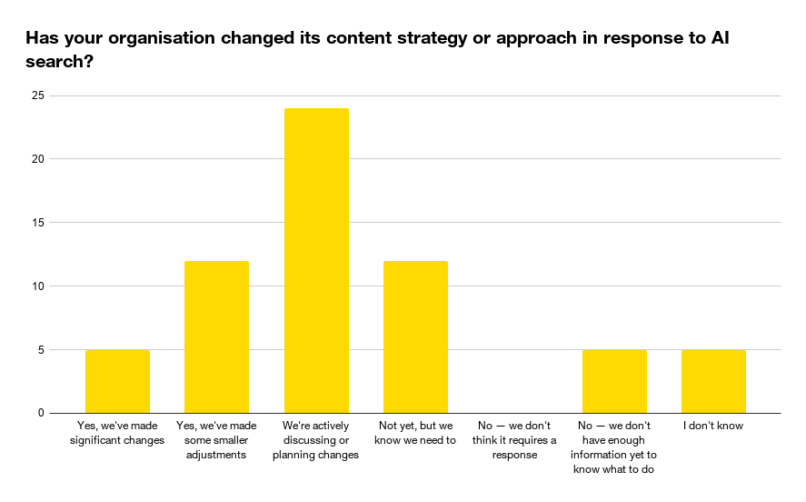
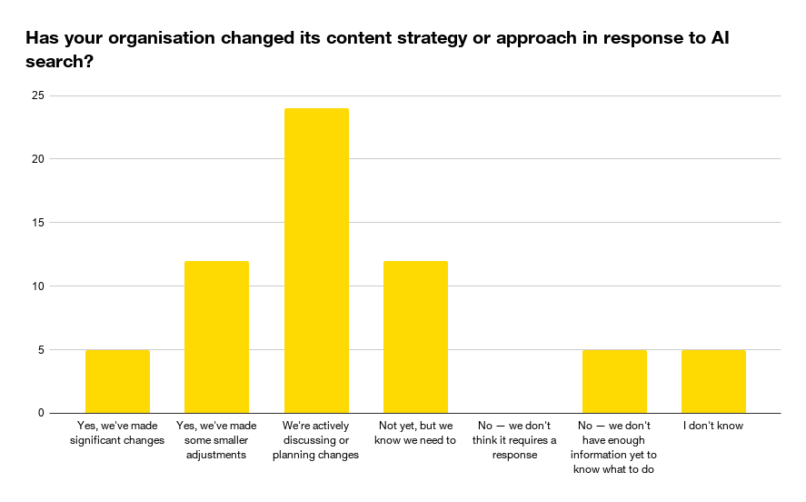
- Most respondents (65%) said that they have not made changes to their content strategy or approach in response to AI search. 38% said that they are actively planning changes. Only 27% have made some kind of change.
- Among those who have made a change, the most common steps people have taken are:
- Monitoring AI search tools to see how our content is represented (54%)
- Creating more structured or schema-marked-up content (44%)
- Auditing or removing thin or outdated content (45%)
Capacity and leadership backing are barriers
- Respondents from smaller charities reported that a lack of capacity was holding them back from making changes and adapting their strategy.
- Some participants from larger organisations reported that leadership engagement or measurement uncertainty was their barrier.
I think internally the risk is that the senior team don’t have the engagement or knowledge in this area to see it as a risk, or not one high enough to put some proper resource behind.
Deep dive: How AI misinformation is affecting charities – and how to mitigate against it
There’s anecdotal evidence from our advisers where they’re having people show up with printed out reams of responses from AI. That can be really hard to advise the clients on, because they trust the AI more than the person sitting in front of them, especially when the AI is more likely to tell them what they want to hear.
This example from the research is representative of a common story shared in the survey and the interviews:
- Users get incorrect information from AI while researching an issue
- They contact a charity’s helpline or service and get different information or advice
- They feel conflicted, surprised and don’t know what to trust
- Calls, emails, chats and appointments are harder or more time-consuming for the charity to handle as a result
The stakes feel higher for some charities too, especially those in areas connected with health or serving vulnerable people. Here, misinformation can have more serious consequences.
Shelter has carried out research on how people are using AI to find advice. They found that:
- 79% of advisers said they are sure some clients ask AI for help before contacting Shelter
- 21% of advisers said AI gives clients incorrect information ‘a lot of the time’; 38% say ‘some of the time’
- 8% of advisers had clients tell them Shelter’s advice is wrong because AI said something different
- 58% of advisers felt clients using AI makes giving advice more difficult
- 57% of advisers said AI makes them less confident about the future
There are two potential reasons why this kind of misinformation might be happening. The first is that the AI could be ‘hallucinating’ – inventing details because the algorithm calculates that they are the right kind of words to use in the response, even though they have no basis in fact. The second is that AI could be finding outdated or inaccurate information on our websites or other sites, and using it in its response. This second scenario can be mitigated through established content strategy best practices. Things like deleting old content, improving thin pages, and adding structure. These things also have benefits for user experience, SEO, and GEO too.
Analysis: Charity leaders need to be aware of AI disintermediation and changing user behaviours
Top ranking pages now get 58 clicks when they would have got 100 before the AI Overviews rollout – Ahrefs study
73% of the public have used AI in their day-to-day life in the past month, and 35% have used generative AI like Chat GPT – UK government study
5% of all ChatGPT messages globally are about healthcare – OpenAI
Declining organic search traffic and the increase in cases of misinformation are already a concern to charity content practitioners, and should probably be a bigger concern for charity leaders. But there’s a far more fundamental shift going on here that’s relevant to both content teams and charity leaders.
The level of AI adoption and usage means that the model we’ve been relying on and using as the cornerstone of digital strategy is breaking. For years, there’s been an unspoken agreement: we create content and make it freely available on our websites. In exchange, search engines and social platforms help people discover that content. Users click through and we can build a relationship, offer support, or ask for a donation. The search engines and social platforms sell ads. Everyone benefits.
AI is breaking this agreement through disintermediation. AI tools still use our content, they just don’t send as many people to our websites. They’re taking content from multiple sources, synthesising it, and delivering it directly to users. People don’t need to visit the source. Or – as the study shows – the users eventually make it to the source, but with poor quality information or unrealistic expectations.
It’s tempting to see this as a traffic problem. But that’s missing the bigger picture: we’re seeing a shift in how people find information online. Generative AI hasn’t completely replaced search. What we are seeing is that it is now one of several parallel paths that people take when they’re looking for information and advice. That poses three challenges for us as content practitioners:
- A user insight challenge in understanding what our users will deploy and trust AI for, and therefore what’s a threat to reach versus what’s a more minor channel shift (plus this is likely to change a lot in the short to mid-term)
- A SEO, GEO and structured content challenge for visibility and accuracy in AI Overviews
- A channel-strategy challenge now that a proportion of users are going straight to Gemini or Chat GPT, and expect to complete tasks in those platforms
Case study: Scope
Scope’s content team carried out research with disabled people and their families to understand how they search for information. They found that behaviour varies a lot: some just use AI, some avoid it, and some sit in between. They also found that people changed the tools and methods they used depending on the task. For a task about PIP (Personal Independence Payment, a state benefit in the UK) some users avoided using AI on the grounds of trust. The complexity of the question also influenced behaviour – some participants were more likely to use a search engine if it was a simple question. However, if the topic was more complex or they wanted tailored information, they were more likely to use AI. Read the full article from Scope
Case study: Patient Information Forum
The Patient Information Forum (PIF) has also been carrying out research in the health sector. They found that:
- 9 in 10 people go online to seek health information
- 7 in 10 use the NHS website or app
- 2 in 10 use Google AI summaries and ChatGPT
- More than 2 in 10 use social media
- More than 6 in 10 ChatGPT users say they ask questions about their health and wellbeing.
Read the full research from PIF.
Case study: The Department for Business and Trade
The team at the Department for Business and Trade found that AI models were often generating misinformation by scraping outdated or fragmented guidance from the Department’s website, among other sources. In response to this, they have:
- Archived old, low-traffic and outdated pages to prevent the out-dated or incorrect information from appearing in AI tools
- Used a dedicated audit and tracking tool (CART – which is not an AI tool) to monitor what content needs to be updated or corrected
- Tested proactive content design processes to ensure that future policies are AI-ready, accurate, and consistently maintained
Read the full presentation from Department for Business and Trade
Takeaways: Ways to address AI’s impact on organic search traffic and content discovery
- Make sure you know what’s happening with your users. If you haven’t carried out research to find out more about how your users are engaging with AI, it’s likely to be worth prioritising this. It could be as simple as a survey on your website and to your mailing list, or you could run some interviews and user testing. The objective should be to learn more about whether your users are using AI, what they use it for, and if they trust it. This will give you a more solid foundation for making any tactical or strategic changes.
- Make sure you know what’s happening to your content. If you’re in a position of responsibility for content and you’re not aware of how AI has affected your organic search traffic, make it a priority to find out. 30% of people in the survey did not know if their organic traffic had changed.
- Understand how you show up. Build up a picture of how your organisation and content are showing up in AI tools. 54% of respondents are monitoring AI search tools to see how their content is represented. Google now offers reports on generative AI performance, and there are also options like Ahrefs Brand Radar and Microsoft Clarity. However, these tools are new, and getting an accurate picture of AI visibility is complex. The traditional keyword and page based SEO impressions and clicks don’t translate to generative AI, so there’s a big learning curve.
- Brief your leaders. If you feel like your leaders do not understand or appreciate the impact AI is having and could have in the future, brief them on:
- How traffic patterns are changing as a result of AI and how this could affect the charity over time
- What you know about how your users are using AI
- Data on, and specific examples of, misinformation in AI and how this is affecting calls, emails, webchats and real life interaction with users
- Get the basics right. If you see evidence of misinformation, or you want to optimise for AI, focus on the established content, usability and readability best practices that are also beneficial for GEO. These kinds of activities are lower risk than focusing on some of the emerging tips for GEO (like adding FAQs), which sometimes contradict good practice for user-focused design. Things like:
- Deleting out-of-date content
- Strengthening content structure, meta data and schema
- Improving old or thin content
- Adding review dates or publishing dates
- Producing more authoritative, original or expert-led content
- Use the AI angle to do best practice work. Consider if using the AI misinformation or GEO angles could help you get buy-in for core content strategy and content design work that you want to do, but have struggled to get support for in the past. These angles might also show the risk of having an under-resourced content team.
- Don’t rush to act without evidence. Don’t feel rushed into acting if you don’t have an evidence-based hypothesis. One interviewee – who leads a team that I see as a leading light in charity content design – said that their choice not to adapt their strategy or tactics was intentional, they felt that there’s not enough data and insight available to make those choices yet. Watchful waiting and gathering evidence is a perfectly acceptable response if you’re already getting the content basics and best practice right.
Read the report section-by-section

Part 2: How charity content practitioners use AI

Part 3: The ethics of AI for charities

Part 4: Organisation-wide policy, leadership, and support on AI

Appendix, reading list and resources

Introduction
About the study
This report draws on primary research carried out in summer 2026. It combines a sector-wide survey of 63 people who produce content, mostly in UK charities and non-profits; 8 in-depth interviews with content leads; and 3 diary studies, in which practitioners logged their use of AI over a week. Survey responses were analysed quantitatively, and free-text answers, interview transcripts and diary entries were coded into themes to find patterns across all three methods.
It was produced with support from William Joseph.