
Report30th September 2026
See the research questions
- Do charity content practitioners have ethical concerns about AI?
- Does AI pose any unique ethical questions for the charity sector?
- Are charities thinking about the ethical implications of using AI and how it might interact with their mission or values?
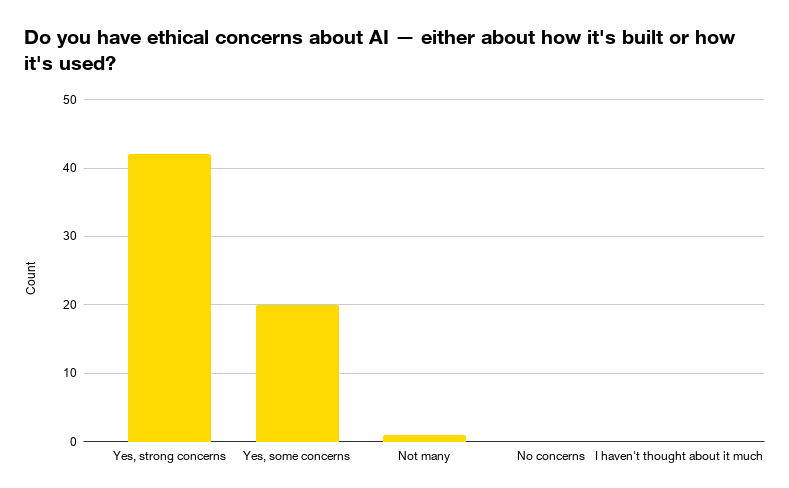
Ethical concerns are near-universal
98%
of respondents said that they have ethical concerns about AI.
- The most common concerns – shared by almost all participants – are:
- environmental impact (79%)
- accuracy (79%)
- ethical concerns about the AI industry itself (79%)
- originality (79%)
- The average participant shared 7 ethical concerns.
People have complex, conflicting feelings about AI
- 51% said that they feel satisfaction – when AI works well. This was the most common response.
- 49% said they feel frustration – when outputs aren’t good enough.
- 48% said they feel guilt or ambivalence about using it.
- 27% reported a sense of pressure or obligation to use it
- 33% said they felt concern about what it means for their role or profession
It has made me lose the love I had for my job. Everything is about AI now – using it to be quicker and create more than humanly possible.
Deep dive: Exploring the depth of negative and conflicting feelings about AI – and the unique concerns for charities
The study revealed a depth of negative and conflicting feelings about using AI, and an angle which is unique to the charity sector.
There’s a high level of concern about AI’s energy, water and data-centre footprint. This was the top ethical issue independent of role, seniority or overall enthusiasm for AI. The free-text answers throughout the survey were also dominated by environmental language even when the question wasn’t specifically about ethics. It’s worth noting that the survey ran in July 2026 – when the climate and nature catastrophe became extremely visible in the UK through heat waves, drought and wildfires. On a personal level, using AI at this moment in time has felt incredibly jarring.
There’s a reasonable chance that AI may become less resource intensive and environmentally damaging over time. Energy is a cost to AI companies, and they want to make as much money as possible, so they will look for ways to reduce this. But it would be naive to think that efficiency gains alone could solve the problem. A UN report found that by 2030, global data centre electricity use will be nearly triple the combined annual electricity use of Pakistan, Bangladesh, and Nigeria (home to more than 650 million people). And the associated water footprint will equal the annual domestic water needs of all 1.3 billion people in Sub-Saharan Africa. The researchers also found that as models become more efficient, they become cheaper and are used more frequently, so the resource reduction from efficiency is cancelled out by volume growth.
The environment was not the only concern. There were plenty more:
- Intellectual property (IP) and copyright: 54% cite ‘copyright or intellectual property’ as a concern they have about AI. Many respondents characterised AI companies as profiting from uncredited, unpaid use of others’ creative and intellectual work. ‘AI steals human-made content, art, music, (my brain cells) and tries to sell it back to us, creating a profit for the few off the backs of the many’
- Bias and reinforcing stereotypes: This is a concern for 63% of respondents. ‘It worries me when people think that it isn’t biased because it’s looking at everything on the internet, but everything on the internet is biased’
- Eroding judgement: The responses also showed a fear that habitual AI use will erode people’s thinking, writing skills or professional judgement over time. This was frequently expressed as a concern for others (juniors, students, the next generation) rather than for the participants themselves. ‘It’s making the job a little too easy. I may have already outsourced my brain! I used to be a really good writer… who knows now!’
Most interestingly, 80% of survey respondents think that using AI in charity content work raises concerns that are specific to the sector – the charity context specifically sharpens their unease, on top of whatever concerns they’d have about AI regardless.
We work on a lot of [campaigns about]… big tech and how it affects human rights, democracy and the environment… we should really be practicing what we preach.
For some respondents, the issue is that using a technology associated with environmental harm, IP extraction or corporate power clashes with what their organisation exists to do. This is different from general environmental or IP-theft concerns covered elsewhere in the study – it’s specifically about internal consistency between mission and practice. For most, this is a personal concern rather than a formal position for the organisation. But at least two organisations in the interview sample have built mission/values considerations explicitly into how they govern AI.
Several respondents framed the AI risk for charities in terms of trust. Charities’ ability to fundraise, deliver services and make change depends on public trust, and they see AI as a threat to that.
Our organisation’s whole selling point is that we are independent and trustworthy. If AI is seen as fake or downright lying to people, then using it hurts us.
It seems like content teams might be feeling this more keenly than their leaders. Only 15% say that they think the ethical implications of AI have been explicitly considered and addressed; 28% think it hasn’t been considered at all.
Analysis: Why aren’t ethical concerns leading to behaviour change?
The survey responses showed a high level of all-round concern about AI ethics, but not a lot of action happening as a result. Or to put it another way: huge amounts of cognitive dissonance.
People (including me) are using these tools even though we know they clash with our values, personally and organisationally. We feel excited about the potential, while knowing that the outputs are often poor quality and cannot be used unedited and unquestioned. The group of people who do not use AI because of their moral objections is a very small one. It’s increasingly hard to resist the allure, the pressure and the hype.
One diary study respondent flagged it as a concern without an impact on their behaviour: ‘It doesn’t impact my day to day decisions, it’s more of a background concern.’ No participants mentioned using more ethical AI options, like privacy-focused tools or less energy-intensive self-hosted AI options. It’s particularly interesting that this is true even of respondents from the organisations that acknowledged a specific tension between AI and their mission, or those that had built considerations about their mission and values into how they govern AI.
This moral disengagement from the ethics and impact of AI feels like a risk. It has the potential to damage the morale of practitioners and even erode the culture of organisations if it’s not addressed.
Takeaways: Ethical ways to approach AI usage
- Know the issues. Think about the limitations of generative AI and the impact that it has before you use it:
- Environmental impact – generative AI tools use substantial natural resources
- Reinforcing bias and stereotypes – AI can reproduce biases and stereotypes in its training data
- Data privacy and security – AI tools rely on gathering large amounts of data and may threaten user privacy
- Human exploitation – some AI companies have exploited workers as part of developing their models
- Other AI applications – some AI companies do more than provide generative AI tools for the public, they might also provide surveillance tools, military intelligence, and other applications.
- Originality and intellectual property – AI content is built on other people’s work, who will not be credited or compensated
- Accuracy – AI might produce incorrect information
- Use your influence. If you’re reading this report, you’re probably not the person in charge of IT procurement for your organisation. But you can still use your influence by sharing your ethical concerns, and getting conversations started about more ethical generative AI options.
- Explore more ethical tools. There are generative AI tools on the market that are aiming to provide a more ethical and sustainable experience,* for example:
- Mistral Vibe: EU based, GDPR compliant
- Lumo by Proton: EU based, privacy focused, open source
- Thaura: EU based, renewable energy, independently owned
- Euria: Switzerland-based, privacy focused, renewable energy, GDPR compliant
- Green PT: EU based, privacy focused, renewable energy, GDPR compliant, open source
- BrowserOS: open source, privacy focused
- Worthwhile Chat: built and governed by non-profits (CAST and The Developer Society), UK and EU-based, privacy focused. This is in beta as of September 2026 and not publicly available.
- Self hosting: You can self-host a large language model via a tool like Ollama or Open WebUI, which gives a high level of privacy, control and ownership, as well as lower energy consumption.
- Only use AI when there’s a real reason to. Use AI mindfully, not as a default. GOV.UK’s Using AI ethically and sustainably puts it well: ‘There are many ways to do a task, and you may not need to use AI. Consider if a simpler tool could do the job (for example, a spreadsheet or search engine). If you do need AI, if your model allows it, pick the smallest one which will do what you need.’
- Consider the cost and whether it is worth it. Vu Le has written a very helpful list of questions to help the sector think through the cost of using AI. How are we:
- harming marginalised communities?
- traumatising people, especially women of color in poorer countries?
- supporting fascism without realising it?
- contributing to the entrenchment of racism and white supremacy?
- destroying the livelihoods of artists?
- creating a more egotistical, sycophantic, narcissistic society?
- enshittifying ourselves and our world?
- perpetuating the injustice that we are trying to fight?
- If you feel guilt, shame or conflict, talk about it. Carrying something like this alone is heavy. If you feel safe to do so, talk to your team and leaders. They may be feeling the same, and it may turn into something productive.
*Ethics can mean a lot of different things. Here, I’m thinking about things like environmental sustainability, independent ownership, GDPR compliance, transparency, not being US-based and therefore not subject to the CLOUD Act, and I’ve tried to explain why the tools have been listed.
Read the report section-by-section

Part 4: Organisation-wide policy, leadership, and support on AI

Appendix, reading list and resources

Introduction

Part 1: AI, organic search traffic and content discovery

Part 2: How charity content practitioners use AI
About the study
This report draws on primary research carried out in summer 2026. It combines a sector-wide survey of 63 people who produce content, mostly in UK charities and non-profits; 8 in-depth interviews with content leads; and 3 diary studies, in which practitioners logged their use of AI over a week. Survey responses were analysed quantitatively, and free-text answers, interview transcripts and diary entries were coded into themes to find patterns across all three methods.
It was produced with support from William Joseph.