
Report30th September 2026

See the research questions
- Are charity content practitioners using AI?
- What tools are they using?
- What are practitioners using AI for, and is it effective?
- Is AI usage individual and informal or part of shared and defined processes
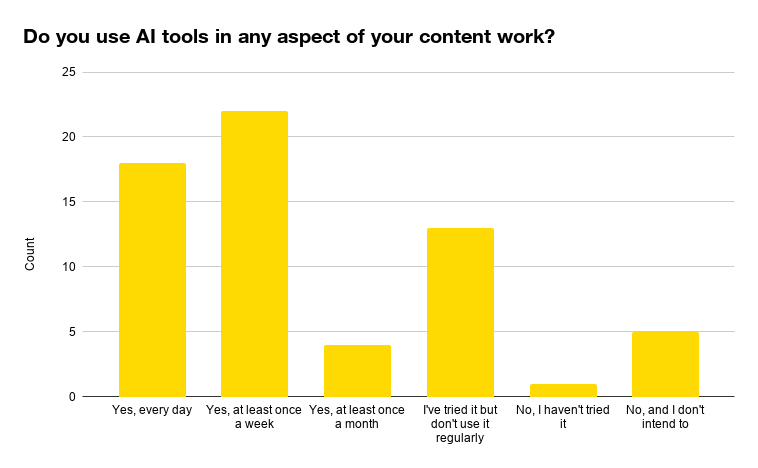
AI use is almost universal
90%
of charity content practitioners use AI
- 64% of respondents are using AI in their work at least once a week.
- 29% use it daily.
- 10% said that they do not use AI tools in any aspect of their content work.
Copilot is the most commonly used tool
- The most commonly used tool is Microsoft Copilot, which is used by 51% of respondents.
- Gemini is the next most common, at 39%.
- Grammarly or other writing assistants are used by 32%.
- Only one participant reported using a bespoke in house AI tool/platform.
AI is most commonly used for drafting, checking, admin and synthesis
- The most common tasks that respondents use AI for are:
- Editing or improving existing copy (50%)
- Proofreading, grammar or tone checking (48%)
- Generating initial drafts or outlines (42%)
- Summarising or condensing content (40%)
- Internal tasks like emails, meeting notes, briefing documents (39%)
Some teams are building custom tools to draft or check content against their guidelines
- 3 participants use AI tools to check content against their guidelines, by building custom tools (for example using custom Gems, or adding guidelines to Grammarly) that can review their content against their style, voice, tone and/or writing guidelines.
- 7 participants specifically mentioned that they use a custom AI agent to draft content based on their voice, tone and/or writing guidelines.
- These participants reported different levels of success:
- ‘We have a custom Gem that has been trained on our style guide… it’s really, really good’
- ‘We have tried to build a custom Gem that other teams can use to get feedback on their copy to make sure it’s in the right tone and style, however, it’s not that intelligent and does get things wrong or makes stuff up (for example it will call someone out for doing something against the style guide, when they haven’t)’
People are asking AI rather than having conversations
- Some respondents reported that they now use AI for questions that they would previously have asked a manager, a peer, or an outside contact.
- Others said that they worry that people are doing this.
I wonder how much the increase in hybrid working is kind of a perfect storm… we’re just going to continually talk to robots rather than each other.
70% deliberately do not use AI for certain tasks
- The most common things that this group said they do not use AI for are:
- Full drafts and long-form writing (‘I would never use it for a first draft of anything long-form because I know what it will produce will be so bad and generic I’d just need to rewrite the whole thing anyway’)
- Imagery, photography and design (‘It’s important we are authentic in our use of imagery and using AI tools to generate images feels in opposition to that principle’)
- Numbers, research and evidence (‘I don’t use it for anything involving numbers because I’ve found it to be too unreliable’)
- Health, clinical and advice content is an area where many practitioners are opting not to use AI. Several respondents reported having formal policies that prohibit using AI to generate this content, because it’s high stakes, needs original thinking, and the kind of deep institutional expertise that AI can’t provide.
We do not use LLMs to generate health information… we do not trust LLMs to be accurate or to convey the correct supportive tone for our service users.
Most AI use is individual and informal
- 52% of respondents described their AI use as ‘mostly individual and informal’.
- 28% said their use is ‘individual but within loose team norms’.
- Only 20% described their use as part of a defined team or organisational approach (10% team, 2% organisation-wide, 8% a mix).
It’s not clear if AI is having a positive impact on work or not
- 35% – the most common response – said that the impact of AI is mixed, with some benefits, some drawbacks.
- 27% said the impact is broadly positive – it helps, though the benefits are modest.
- 14% said it is having a very positive impact, and significantly improving the quality or efficiency of their work.
- 8% said the impact is broadly negative, creating more problems than it solves.
Case study: Parkinson’s UK
Parkinson’s UK has a specific policy guiding how its content team uses generative AI for health content. The policy states that the team will not use generative AI to author health content. It also provides examples of how AI can be used in relation to health content, along with principles for responsible use.
Thanks to Pia Dawson for sharing this example with me.
Deep dive: The conflict over using AI to write content
The research uncovered some interesting ideas and some real conflict about using AI to write content. 42% said that they are using AI for generating initial drafts or outlines – a way of helping them get past the intimidation of a blank page.
It helps me get over the initial fear on the blank sheet.
When I dug into the data, I found a pattern in this group that I’m calling ‘drafters’, (with a caveat that this is a small pool – 26 people). In the survey responses, drafting content with AI is associated with more frequent, self-directed, ungoverned AI use, and a positive attitude to AI. This group are daily users of tools that they pay for themselves, working for organisations without an AI policy, and with fewer concerns about the tech. This might be a sign of more agile organisations, or of a lower level of digital maturity.
For another group of respondents, staring at a blank page and having to generate the first version of something isn’t a chore to be automated away – it’s the heart of what they do as content practitioners. The blank page is where the thinking happens and where they work out how to solve for the user need. If AI fills that page, they are reacting to and editing the AI’s framing rather than establishing their own – even if they rewrite every word afterwards.
The blank page is the hardest because it is the most valuable.
I dug into the data for this ‘non-drafter’ group too, and found that there are some non-drafters who are regular AI users, and feel good about using AI too. For this group, refusing to draft with AI isn’t the same as being uncomfortable with using AI – they just don’t think writing is a good use case for the technology. On the other hand, there are those who do not use AI because of their overall ethical concerns.
I was hired because I have the skills to write and design content, not because I have the skills to ask an AI the right questions to write and design content. Until AI surpasses my ability to write in the right voice in the right contexts with nuance and understanding I will continue to do those tasks myself.
Analysis: Even ‘safe’ individual uses of AI have risks – and coordinated, team-level applications are likely to have the biggest impact
What I can see emerging from the study is a sense that there are ‘safe’ uses of AI. Things like summarising, data-wrangling, transcription, capturing meeting notes, using an agent as a personal sounding board. These tend to be individual activities that people do alone as part of their own workflows, and that are seen as freeing up time and capacity for work that makes better use of their skills. The kind of work – like drafting content or making judgements – that would be riskier to use AI for.
However, there is still risk in these kinds of AI applications. Firstly, AI makes a lot of mistakes, even with simple tasks like synthesis and transcription. The 2026 AI Index Report from Stanford HAI found that AI accuracy is still lower than human accuracy, and in a benchmark, hallucination rates across 26 top AI models are between 22% to 94%. One in five times, AI will get it wrong – that’s the best case scenario.
AI models can win a gold medal at the International Mathematical Olympiad but cannot reliably tell time
Stanford HAI AI Index Report
There’s also a much bigger, more insidious risk – skipping some of this work is skipping important thinking. Tasks like writing meeting notes might feel like drudgery, but they play an important role in cognition and understanding. The process of writing something down means we have to engage with it in a more active way than when we just read something. On a personal note, I was excited to use AI to create user and stakeholder interview summaries because of the time saving, but stopped doing it after realising that it was leading to poorer outputs because I didn’t have the same level of understanding of the data.
Even if you write down (or, let’s face it, have an AI transcribe) a meeting or an interview into a document, knowledge does not automatically come along with that text. Knowledge is something that is produced in your brain as you transcribe the text, because transcription is an act of metacognition. It is synthesis. It is thinking.
Pavel Samsonov
There’s something complex and a bit painful to grapple with here. I’ve never worked with a charity content team that wasn’t over capacity and under-resourced. The idea that AI can take away some of the work is appealing. It can also feel like we have a responsibility to use it, so that we can do more with our donations and funding. But we need to balance that moral imperative with risk mitigation.
I heard Ellen Gofton use the analogy of the Sorcerer’s Apprentice to describe this. The young apprentice to a powerful sorcerer is tasked with fetching water. Left unsupervised, he decides the best way to do it is to magic himself more buckets and mops to carry it. Spoiler: it’s not the best way. Chaos and a flood ensue. More people using more generative AI prompts isn’t always the way to a better output, and it has potential to get messy.
One way to avoid some of the risks is to look for team-wide, visible applications for AI. The Stanford report found that productivity gains from AI are largest in structured, measurable work where the outputs are easy to monitor. And when all AI usage is individual and hidden (even inadvertently) there’s a risk of poor practice and inefficiency. As one content leader put it ‘because the way that we work is so integrated, it’s really important to know if someone is using AI. They need to be open about that’. The survey data itself backs this up; the people who say AI is having a very positive impact are more likely to:
- work at organisations that have given them training and guidance on how to use AI
- say that they feel fairly or very well supported by their organisation in using AI.
In a talk at Lead With Tempo, Google’s Tim Hetland described the concept of AI model behaviour design, which gives a good steer on what ‘team wide and visible’ looks like in practice.
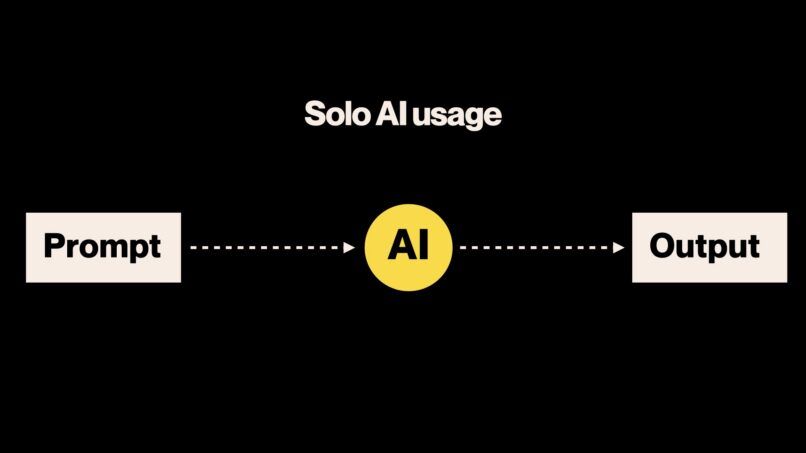
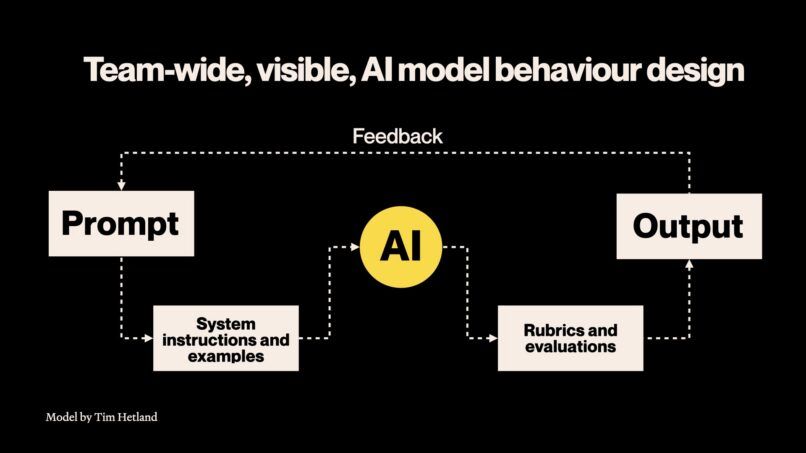
In this approach, system instructions and examples mean that AI has a basis for what good looks like. Evaluations and rubrics mean the AI can self-correct and critique. And the feedback loop means the system gets better over time. Individual, ‘shadow’ AI use might skip these steps, or take them but not share the benefits among the team, and can compound poor quality as a result. I’d say there’s a step before the prompt too, which is ensuring that the work you’re doing is aligned to your strategy and user needs.
Examples like Tim’s approach to model behavior design show the value of looking outside the charity sector for a view on what the future might look like. Product and tech sector content design has already ridden the AI rollercoaster. There have been waves of layoffs that have affected content folks specifically. But there are also a range of new AI-focused content roles, and in some places, a new appreciation of the skills that content practitioners have. Let’s not forget that large language models are at the heart of generative AI. Understanding language, words and how they work is an increasingly valuable skill. As charities experiment more with building AI tools and interfaces for users, content teams should be at the heart of that development.
Case study: Citizen’s Advice
At Citizen’s Advice, the Innovation and AI team has created a custom Gem in Google Gemini to streamline the brief creation process. The content designer and subject expert have a 15-minute call using a predefined list of questions to capture necessary information. They download the transcript of the call and paste it into the custom Gem. The Gem summarises the transcript and formats it into a summary which is then pasted into Jira. This ensures the person picking up the ticket has full context and a clear understanding of what is expected before they begin drafting. This approach aims to reduce misunderstanding and back-and-forth communication between team members. Thanks to Phoebe Nightingale for sharing this example with me.
Takeaways: Ways to use and govern AI in your content team
- Root your choices about AI in your mission and users. Before you use AI, ask some questions about the compromise you’re making, to understand if it’s a good one, or just an easy one:
- Do you need more content/this content? AI makes it easy to create more content faster. But more content doesn’t always mean better or more effective. Will making more content help? Is there a true user need for the thing you’re about to make?
- What’s actually blocking your team, and can AI fix that? Look at the things that are really affecting your team. If the blocker is a lack of strategy, AI can’t fix that. If it’s a lack of data and insight, AI can help you process it faster, but it can’t fill a void or replace the judgement of knowing what matters. If it’s poor collaboration, no AI tool can fix that.
- Where can AI free up time? What work really doesn’t need your time and attention, or needs less of your time and attention? Is compromising on this going to give you more time, energy and attention to work on something more impactful?
- Create your own policy. Create an AI policy or guidelines for your content team to provide guardrails on what AI should and should not not be used for. This could be a good option if your organisation as a whole is not providing AI policy, or if you have sensitive, high-profile, or high-risk content that needs to be handled carefully
- Consider the risks of using AI in ‘blank page’ scenarios. By ‘blank page’, I mean situations where you don’t have previous material, in-house expertise, or precedent for how to solve the problem. In those scenarios, will you be able to effectively prompt, check any outputs, and maintain the results? If not, is using AI too high risk? This is a particular risk if you use AI to create interactive content.
- Make sure you know what’s going on with AI in your team. Set an expectation that people should declare when they use AI, but also create a sense of safety in sharing. In order to share freely, people need to know they will be met with support, curiosity and care, rather than judgement. (Giving people clear parameters on the things they shouldn’t use AI for is necessary to underpin this.)
- Look at ways to use AI as a team. Explore how AI could be beneficial as part of your established practices and process. That might look like:
- Building a library of tried, tested and refined prompts
- Developing your own agents, prompts, and skills
- Using AI to support your existing processes.
- Set the expectation that every single AI output should be checked. As well as this, give people some ideas on how to go about it. For example, if you use AI to:
- transcribe a call – read the transcript and correct it if necessary before you share it
- summarise a document or write up notes – check that all quotes can be found in the materials, and check c.10% of notes against the originals to make sure that no errors are appearing
- Don’t let asking AI become the default way you get an answer. AI isn’t the best option for every kind of question. Keep having human conversations – with managers, with peers, with external contacts – to expand your thinking.
Other ways that you could use AI in your content team
- Creating formulaic, repetitive content at scale. In product content design, teams are increasingly creating and managing large volumes of content with AI. Structured, formula-driven copy – things like button text, error messages, notifications – can be created by AI that’s been fed with system instructions and examples. Look at your content ecosystem – what repetitive content do you have, and how much time does it take? Could building an agent help speed up the process of creating event listings, service directory entries, or something else?
- Checking content quality against guidelines and standards. You could build a custom agent that checks drafts against your content guidelines – voice, tone, style, accessibility, etc. Would this help colleagues outside the content team develop better drafts? Could it reduce the amount of time your team has to spend on checking content?
- Converting, localising and translating content: Using AI to convert content into easy read/audio formats or translating into different languages. Would this help you to deliver content to more users? Would it speed up the process so that staff only have to review and refine? Could it help you meet a user need you couldn’t otherwise meet? Is the quality acceptable?
- Building the things you don’t have the budget or capability to build: Using AI’s coding ability to create content like interactive tools or visualisations. Would this enable something you couldn’t otherwise afford to do? Can AI add skills your team lacks? Could it help you meet a user need you couldn’t otherwise meet?
- Helping people who struggle with writing to draft or contribute to content: Speaking to an AI tool or answering a list of programmed questions can be easier and more accessible than writing for some people (especially for some neurodiverse and disabled people). Could AI help you get subject matter expertise more easily? Could it make it easier to get inputs from people with lived experience?
Case study: RNIB
The RNIB is using AI to convert content into accessible formats like Braille, audio and large print. It has an AI solution called Mailings that automatically extracts and converts content, before a member of staff reviews it for accuracy. It has cut conversion time for content from as long as two weeks to as little as 3 hours.
Source: Royal National Institute of Blind People & Microsoft
Read the report section-by-section

Part 3: The ethics of AI for charities

Part 4: Organisation-wide policy, leadership, and support on AI

Appendix, reading list and resources

Introduction

Part 1: AI, organic search traffic and content discovery
About the study
This report draws on primary research carried out in summer 2026. It combines a sector-wide survey of 63 people who produce content, mostly in UK charities and non-profits; 8 in-depth interviews with content leads; and 3 diary studies, in which practitioners logged their use of AI over a week. Survey responses were analysed quantitatively, and free-text answers, interview transcripts and diary entries were coded into themes to find patterns across all three methods.
It was produced with support from William Joseph.