
Guide

Back when I started working in content, planning was a pretty simple process. I had one channel – the company website – and it was easy to keep track of upcoming projects, stakeholder requests, and business as usual maintenance in a basic editorial calendar in Excel.
It’s not so simple now. The shift towards user-focused content means there’s a better understanding of different audiences, segments, and user needs. The number of channels and formats has grown. Content has become a critical resource, meaning more stakeholders and more briefs.
All this makes planning a lot harder. There are lots of different factors and criteria to balance, and choosing the right things to focus on can be challenging.
So in this article, we’re going to look at how to approach content planning in a strategic, user-focused way that increases the chances of getting the right content to the right audience at the right time.
Why you need to plan your content
Content planning is the process where you decide what content you and your team will create, curate, and update in order to meet your organisation’s objectives and your user needs. (And what you’re not going to do too.)
It’s the stage in your overall content lifecycle where you do a few really important things:
- Think longer-term/at a campaign level. I’d suggest doing this kind of planning on an annual basis, with sessions to get into more specific detail once a quarter. You might also want to do this kind of planning for specific campaigns or projects. This is the moment where you carve out time for the big areas of focus and key projects, rather than the more reactive, triage-style planning you might do on a weekly basis.
- Balance your content mix. Planning is an opportunity to check that you have the right mix of content to meet user needs and achieve your objectives.
- Reflect on performance. It’s a great time to look at performance data and impact, and check that what you’re doing is working.
- Look outside. Take a look outside your organisation and think about how you need to respond to things going on in the wider world
Inputs to help you plan your content
There are few key inputs that you ideally need to have to plan content effectively:
- A content strategy and objectives: our strategy should be the touchstone for your content planning. It’s there to give you direction and decision-making tools that help you settle on the right activities to achieve your objectives. Whether you’re creating a general content plan for all your activity, or a plan for a specific campaign or project, you need objectives or goals. You can’t plan effectively if you don’t know what you’re aiming to achieve. As always, these goals should be SMART (Specific, Measurable, Achievable, Relevant, Time-bound).
- User insight: Insights that help you understand your audience and what they need from your organisation are another critical input. In my experience, demographic data (age, location, profession, etc.) is a lot less useful for content planning than user needs and user journeys. These give you a far clearer picture of the task your audience has in mind, and where you’re going to find them online, which is really valuable for planning.
- Performance data: Data on how your current content or relevant past content performs against your KPIs and objectives. Knowing – objectively – how well your content has performed makes a big difference to how effectively you can plan. The metrics and KPIs you use matter, and should be specific to the kind of content and its purpose. For example, impressions might be a good KPI for content that was designed to create awareness, but it would be a bad KPI for something like advice content where the intention was to support a specific audience.
- Market/external insights: Finally, insights from your market, sector and comparators, trends, and general inspiration. This is an important input for ensuring that your content is relevant and timely. It can also be very useful for sparking new ideas.
You can still plan without these things, but it’s going to be a lot harder. You might find yourself taking a more reactive or tactical approach, or prioritising things that don’t actually make that much of an impact where it matters.
How to use them
Bring all of these insights together in a briefing and share them as a pre-read before your planning session. You may also want to dedicate part of your planning session agenda to discussion. Sharing insights like this will help get better outcomes from the team doing the planning.
It can be helpful to share them with stakeholders too, if they’re not part of the planning process itself. It can help them to see the different needs and expectations you’re trying to balance.
Models that can help with balancing content planning
There are three models that I find helpful for creating a balanced content plan. By balanced, I mean a content plan that has the right mix of different kinds of content to meet user needs.
Push and pull
Push and pull is an idea that I first heard about from Sarah Winters. The idea is that content moves in two directions:
- Push content is content that the brand pushes out to the user. They might pay attention, or they might not. They don’t have to make any effort to find it, but you’re interrupting them with it, so it needs to be appealing and worth their attention e.g. advertising, paid media.
- Pull content is content that the user pulls to them. They actively seek it out, by searching or going direct. This content has to meet their needs or they’ll look elsewhere e.g. searching, subscribing.
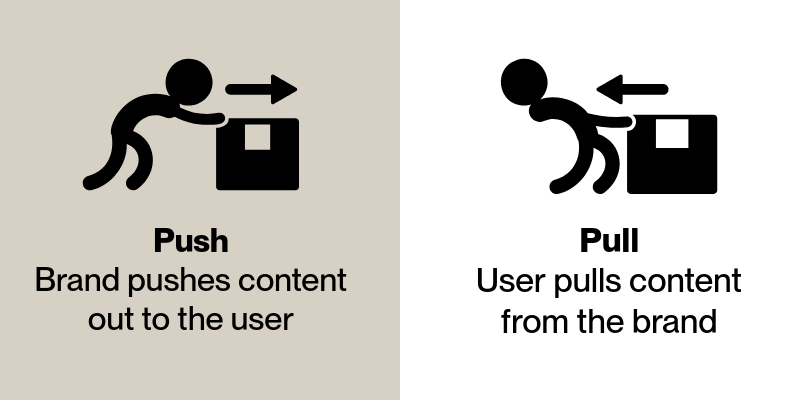
You need both of these kinds of content, but some organisations overlook pull content. So it makes sense to consider whether you have the right balance of push and pull as you’re doing your planning.
Knowing whether you’re pushing or the user is pulling can help you choose the right channel and format too. For example, if you know users want ‘how to’ content, it’s likely this will work better as pull content optimised for search, than it would as push content like paid media.
User decision journey
The second model is the user decision journey. This model is about having a realistic view of the steps your audience goes through in their interaction with your brand. It’s also about consigning the ‘funnel’ to history.
‘What’s wrong with the funnel?’, you might be wondering. Well, the funnel treats your users as sausage meat rather than human beings. It’s brand-centric rather than user-centric. It doesn’t acknowledge that people don’t take a linear path. It stops at the point of purchase, or other goals like a donation, and ignores the rest of the user journey. In short, it’s not helping you plan better content.
Instead, you should be using something like this:
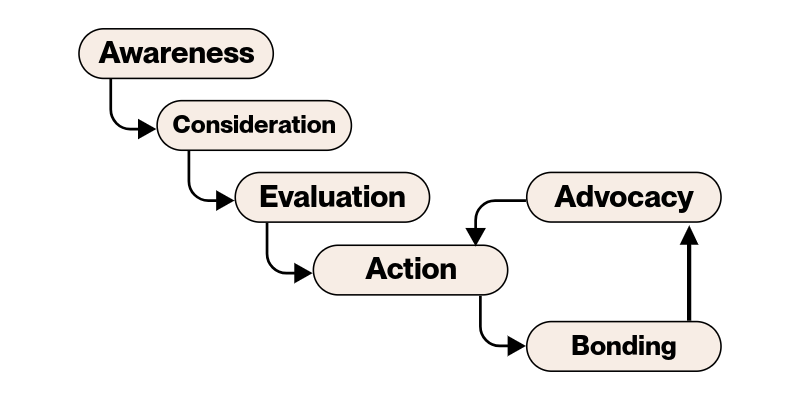
The key differences between this model – inspired by McKinsey’s customer decision journey – and the funnel are:
- It does a better job of reflecting that your users are likely to be looking at other options and doing other things. They are not solely focused on your brand (in most situations at least). They will be ‘pulling’ content to help them make a comparison and decision, as well as seeing whatever you’re ‘pushing’.
- It introduces the ‘loyalty loop’ – the idea that if you create a great experience, that user will come back for more, without returning to the start of the cycle next time. They may advocate for your brand too, creating awareness among a new audience.
The user decision journey gives you a more nuanced understanding of what users are doing. This means you can plan more useful and targeted content. For example, looking at the experience someone has right after they take an action might mean you introduce troubleshooting content to tackle common problems.
Firework, spark, campfire
The final model describes the different cadences of content you can use to reach your audience and that you need to consider in your planning.
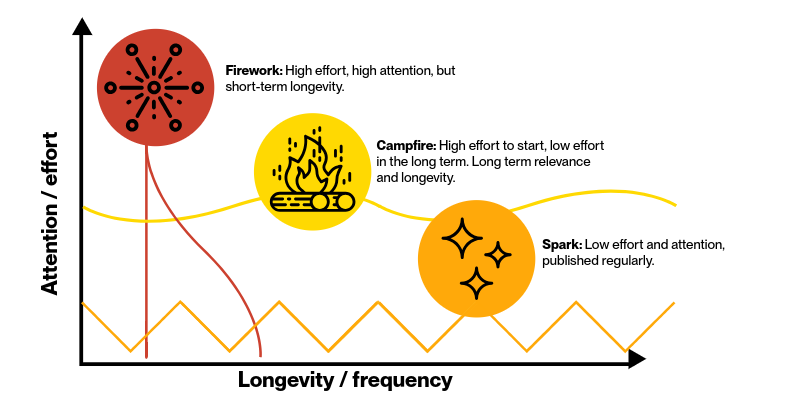
The three cadences are:
- Firework: One-off content with a big impact in terms of attention, but for a short period, e.g. campaigns, launches, ‘tent pole’ moments, hero content. This content can be expensive to produce. It requires a lot of amplification and paid media to make it successful.
- Spark: Content published on a daily or weekly basis to give a fresh, seasonal, or relevant perspective. It has a short life-span, e.g. seasonal promotions, reactive content, curated content, news. This content is inexpensive to produce. It may need some amplification and paid media behind it.
- Campfire: Slow burn content that’s always relevant to your audience and has a long life-span (if you keep feeding it, it could last forever). It’s also known as evergreen content, e.g. how tos, product info, advice and education. This content takes time to do well — it requires UX-thinking and careful design. It will repay the investment over time, because it should generate sustained interest for years.
Many brands focus on just one of these, but you need a mix of all three if you want to meet user needs. Your users and their needs should lead the ratio, but in my experience, most brands under-invest in campfire content. It’s not the most exciting ‘shiny’ stuff, but hugely important.
For example, I used to work at an energy price comparison site. When I joined, some of the top-performing pages in terms of conversion were content pages that had been on the site for about a decade. I checked, and they’re still on the site now – they’ve evolved over the years, but they’re essentially the same. The secret to their longevity? They respond to customer needs and are genuinely useful.
Bringing the models together
You can use any of these models on their own, but the real value comes when you use them together. When you combine them, you get a decision-making tool that can help guide your planning.
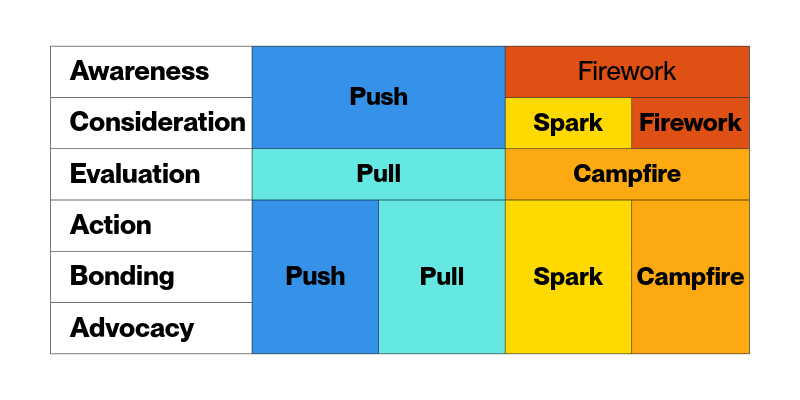
For example, if you were setting out to create content to help your user evaluate your offering against a competitor, you’d know that you’d need to create campfire content that the user could pull – giving you a good sign that content optimised for search would be your best bet.
It can help you work out where your gaps are too. If you plot your content on the map, you can spot misdirected efforts, or where you’re not doing enough at the moment.
You can also add your channels and platforms to the model to ensure they’re used consistently. For example if your metrics show your emails have a strong conversion rate, you’d want to make sure you use them as much as possible for push ‘action’ content, but also that you’re encouraging people to sign up to your mailing list in the ‘consider’ stages with regular push ‘spark’ content.
Don’t forget the maintenance
Don’t forget the content you already have. Your ‘campfire’ evergreen content needs to be refreshed and maintained from time to time, and there might be seasonal triggers that mean you can promote it on other channels.
For example, an animal welfare charity might have evergreen content about keeping pets safe in summer heat. Considering evergreen content when you’re planning means that you might decide to refresh that content and share it in an email to a relevant audience.
In conclusion
- Effective content planning hinges on a strategic, user-centric approach that ensures your content finds the right person at the right time.
- Base your content planning on robust data, including content strategy and objectives, user insights, performance analytics, and market/external insights.
- Use frameworks such as push and pull content, the user decision journey, and the firework, spark, and campfire content cadences to build a diverse and effective content mix.
- By understanding the interplay of these models, you can find content gaps, better use your channels, and ultimately create more impactful content.
- Don’t overlook the importance of maintaining your existing content to ensure it stays relevant and valuable.
First published: 4th June 2019
Published: 21st July 2025
Related resources
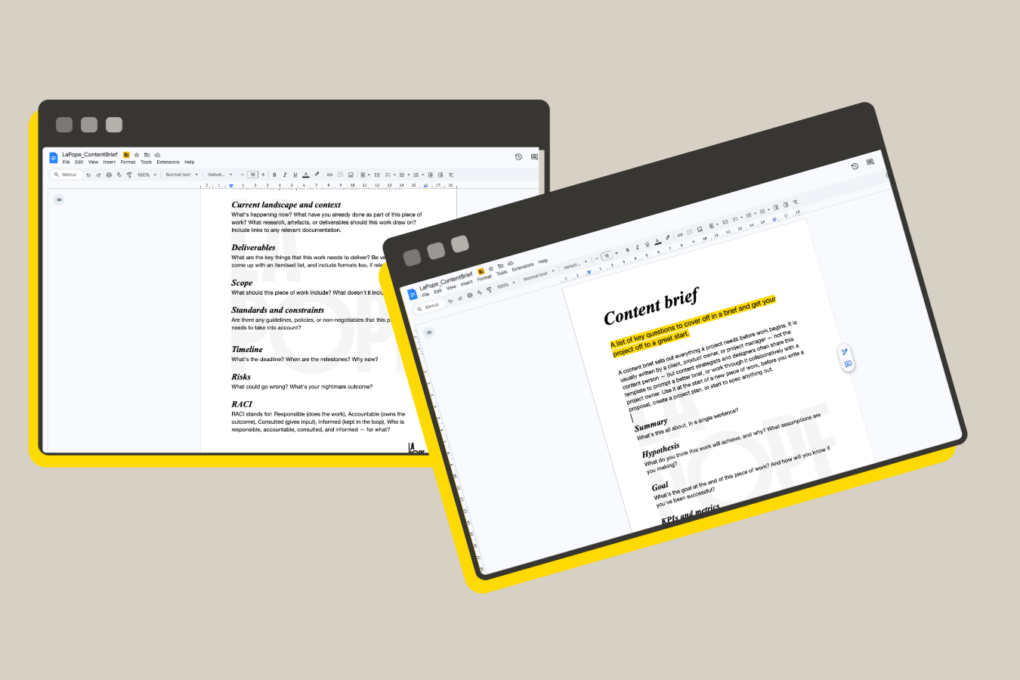
Content project brief template
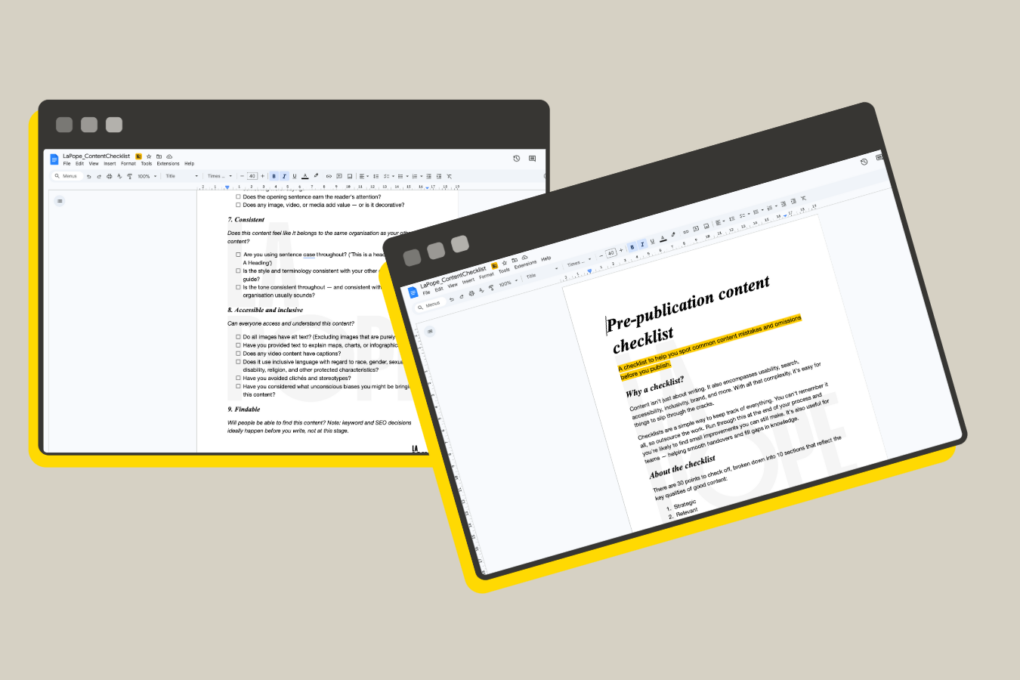
Prepublication content checklist